This is part two of the Anne Smith, Mary Ann Smith, Jem Smith story.
Anne or Ann Curran, the daughter of Irish ‘hawker’ John Curran, was twenty years old when she married James (Jem) Smith on the 24th September 1883 at St Peter’s Church in the Parish of West Hackney. Fifteen months later, after a bareknuckle fight with Jack Davis, Jem was declared Heavyweight Champion of England.
Anne and Jem’s marriage record indicates that as a young labourer (son of William Smith, a coal trimmer on the docks) Jem Smith could not read or write. While Anne’s name is signed, Smith marked only an X.
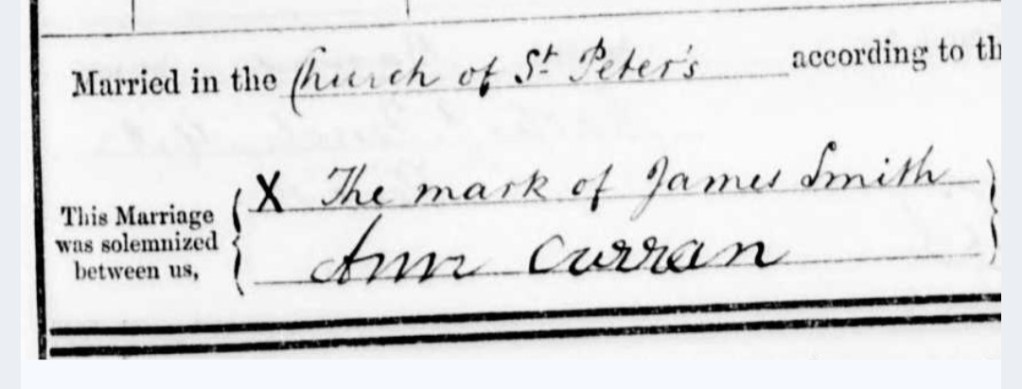
I had my suspicions about Jem Smith’s literacy, due to one reference in a late 1880s newspaper report of his training schedule, where it was observed by a reporter that Smith liked to have the Sporting Life newspaper read to him by his trainer, rather than reading it himself. But perhaps he was just lazy, and liked the sound of someone else’s voice.
When Jem later retired from active boxing, he spent many years working as a commission agent, or betting agent, in the horseracing world, and it’s likely that he had some level of literacy by then. He also looks to have signed the 1911 census, the first one where heads of households were asked to fill in the records themselves.
The marriage record for Anne and Jem and some of the other information found in this post were shared with me by two generous researchers – Charlotte MacKenzie and Ash Paley, who both got in touch after reading part one of Anne, Mary Ann and Jem Smith’s story.
I’m hugely appreciative of the time and effort they put into tackling the challenge of missing information and the questions I had about who was married to who, legally or not, where and when.
Why am I so bothered, is the question here? Well, Jem Smith was a HUGE national, and transatlantic, celebrity in the 1880s. The Tyson Fury of his day, if you will. If Netflix had existed he’d have had a docuseries following his 50lb weight losses and regular in-ring fuck-ups.
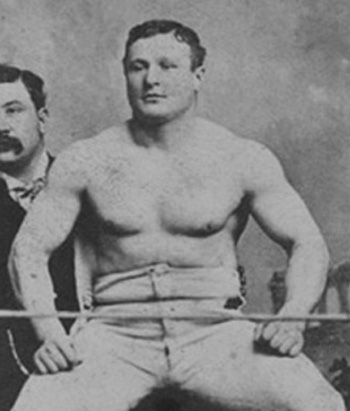
Quite a bit is out there on YouTube and in boxing history books about his career. There’s a chapter about his career – moderately detailed – in my forthcoming book too, and I could have written 100,000 words more. He fought, he boxed, he had an astonishingly ripped physique in his youth. All good stuff which is not too hard to find, or write. But I’m a 39 year old woman. I’m nosy. I’ve dated dodgy pugilists. I just wanted to know about his love life.
So: Anne and Jem look to have been legally wed in 1883, in the presence of Margaret Curran, Anne’s sister. In 1891, Margaret would marry John Bashford and become the Mrs Margaret Bashford we meet in 1915, who got into trouble with the coroner at Anne’s inquest for refusing to disclose Jem Smith’s address.
Anne was Ann at her wedding, Annie while a witness at Margaret’s wedding, and Ann or Anne interchangeably in the reports from the inquest. I wonder whether the Annie Bridget Smith I have found buried in Southwark in the August of 1915 (because it’s the only burial I’ve found for an Anne/Ann/Annie Smith in London in the August of 1915) may be her. To be confirmed.
The surname Curran is of Irish origin, and the middle-name Bridget does, of course, strongly hint at Irish heritage.
Funnily enough, for the woman who married the soon-to-be Heavyweight Champion of England, Curran looks to have its etymology – the internet tells me – in ‘curraidh’, which translates to ‘hero’ or ‘champion’.
I believe Anne Curran to be the Annie Curran we can find on the 1881 census living at 2, Longs Buildings, St Luke, Holborn – daughter of Irish-born John (‘Hawker’) and his equally Irish wife, Mary. Anne’s siblings John, Margaret, Edward and Thomas are there too, and we can see that the teenage Annie was an ‘Ironer’ before her marriage to Jem Smith.
Neither Ash, Charlotte or I have been able to find any record of a legal marriage between Jem Smith and Mary Ann Smith after his split with Anne, and it looks likely, as I suspected, that the pair were in a common-law marriage only. Jem probably never legally divorced Anne. Despite their marriage only lasting a few years – from 1883 to around 1886 (because later censuses suggest he was ‘married’ to Mary Ann from 1886) he continued to support Anne financially up until her death in 1915.
In my previous post I noted, jokingly, that the 1911 census has Mary Ann’s relationship to the head of household (Jem) as housekeeper, rather than as wife. Her occupation is also given as housekeeper. I think it’s likely that this was a mistake, and the (semi-literate…) Jem filled in the wrong column.
But interestingly, when you get to the final census on which Jem and Mary Ann appear, the 1921, their relationship is even more incongruous. Mary Ann’s status in 1921 is ‘married’. Jem Smith’s is ‘widowed’. He was widowed from Anne – the first wife – so that’s technically correct. But does this mean that Mary Ann’s saying she’s married to Jem? Or was she still married to someone else from decades’ back too, and never divorced or widowed from him? I’m not quite there with that mystery, yet.
In the early 1920s, Mary Ann and Jem (both 58) were living with Mary Ann’s elderly mother, Ann Learoyd, and the couple had finally moved on from Torbay Road, to a five room apartment at 84 Salusbury Road, a ten minute walk away.
It is through the 1921 census that we discover what Mary Ann’s name was before she was the common law wife of Jem and the second Mrs Smith – Mary Ann Learoyd.
Born in Bethnal Green in 1864, she had been a dressmaker as a teenager and lived at 307 Bethnal Green Road – it’s a corner property today (I’m not sure if the street’s numbers have changed), directly opposite the Marquis of Cornwallis pub.
After some 44 years of living with Jem as husband and wife, Mary Ann died in 1930, and was followed by Jem a few months later. Charlotte Mackenzie has found probate index entries for both Mary Ann and her mother. Ann Learoyd died in 1927 aged around 86 and left Mary Ann the sum of £19.
Mary Ann (and presumably Jem) had continued to live on at 84 (flat D) Salusbury Road until she died in 1930 at the Northern Hospital on Holloway Road. Her probate entry shows her to have left the rather large sum of £806 – £47,000 in today’s money – to James Edward Smith (that’s the first and only sign of his middle name I’ve ever seen) and to her brother Alfred.
None of us who have looked into it so far have been able to find a probate index for Jem when he died in 1931 – we have only newspaper reports of the auctioning off and giving away of his trophies, belts, and ‘outsized’ suits.
Anne Smith was portrayed in the newspapers as an alcoholic woman in her early fifties when she died, battered and bruised from drunken falls, having not seen her husband for decades. We still do not know why their marriage ended after just three or so years, who left who, or why. But it appears that she had gone on to live alone in what was probably rather miserable circumstances. Perhaps. Might she, actually, have had quite some life between the 1880s and the alcohol really taking grip? Maybe. I don’t know. Her inquest made headlines across the UK by virtue only of her being Jem Smith’s first, abandoned, wife.
From newspapers, from gossip, Anne or Ann or Annie no doubt had some knowledge over the decades of the comfortable life Jem had made for himself and her replacement, Mary Ann, from the late 1880s, through his wealthy backers and big pay packets in the boxing ring. The circumstances of whether Anne had given birth to children and then lost them, as was hinted at in some of the newspaper coverage around her death, is still not known. Nor is it entirely clear that the son born to Jem Smith and Mary Ann in 1888 – little James, who died as a child – was definitely Mary Ann’s. Might he have been Anne and Jem’s, and Jem had taken him with him as a baby when he moved on and in with Mary Ann?
What we have found might just be snippets, but I’m so glad to know a little more about Anne. And Mary Ann too. We know where Anne grew up, that she had siblings, that she worked as a young woman, and that she was Irish.
We don’t really know her. But we know that Anne was more than just the woman who spent the champion’s one pound a week on whisky.
 Rediscovering the wrestlers and boxers of Late-Victorian London
Leave a comment