In April and May 2025 I published two blogs presenting my research exploring the life of Felix Augustus Scott. You can read them here:
- Barbados to Birmingham and Much In-Between: The Many Lives of the Champion Felix Scott (Part I)
- “Nothing but blows and unkindness”: The Many Lives of the Champion Felix Scott (Part II)
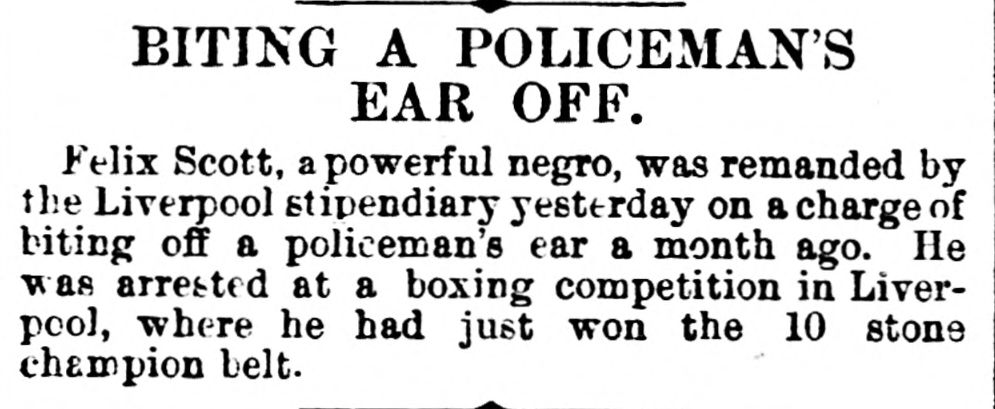
Born in Barbados in 1856, we first met Scott when he was court martialled and imprisoned in Winchester, England – he’s there on the 1881 census. After his release he travelled, built a reputation as a talented boxer in Liverpool and later in London… while on the run from biting a chunk out of a policeman’s ear.
It was very much an unofficial title, but he was arguably the first ‘Black British Champion’, after competing with Hezekiah Moscow in the final of an all-Black tournament off Fleet Street, London.
He also won a major ten stone (140lb) tournament in front of the great and good of the late 1880s boxing world – and was then arrested as soon as he was crowned ‘Ten Stone Champion’. He served a year for the ear-incident.
I was not the first person to look into and publish research online about Scott (as I believe I was with Moscow’s story in 2019!) – a blog by Jamie Calladine, who was then a volunteer researcher for National Museums Liverpool, got there first. But Calladine’s piece delved little into Scott’s later career, nor did it explore much of his personal life.
Scott’s relationships are where things get tricky. For all his achievements and fearsome reputation in the ring, and for all the admiration we can have for him as something of a pioneering figure in the sport – as a boxer, then a trainer, gym manager, promotor, and someone I believe might have been the first Black proprietor of a travelling boxing booth or pavilion (rather than just an employee), he was a deeply problematic character when it comes his treatment of women.
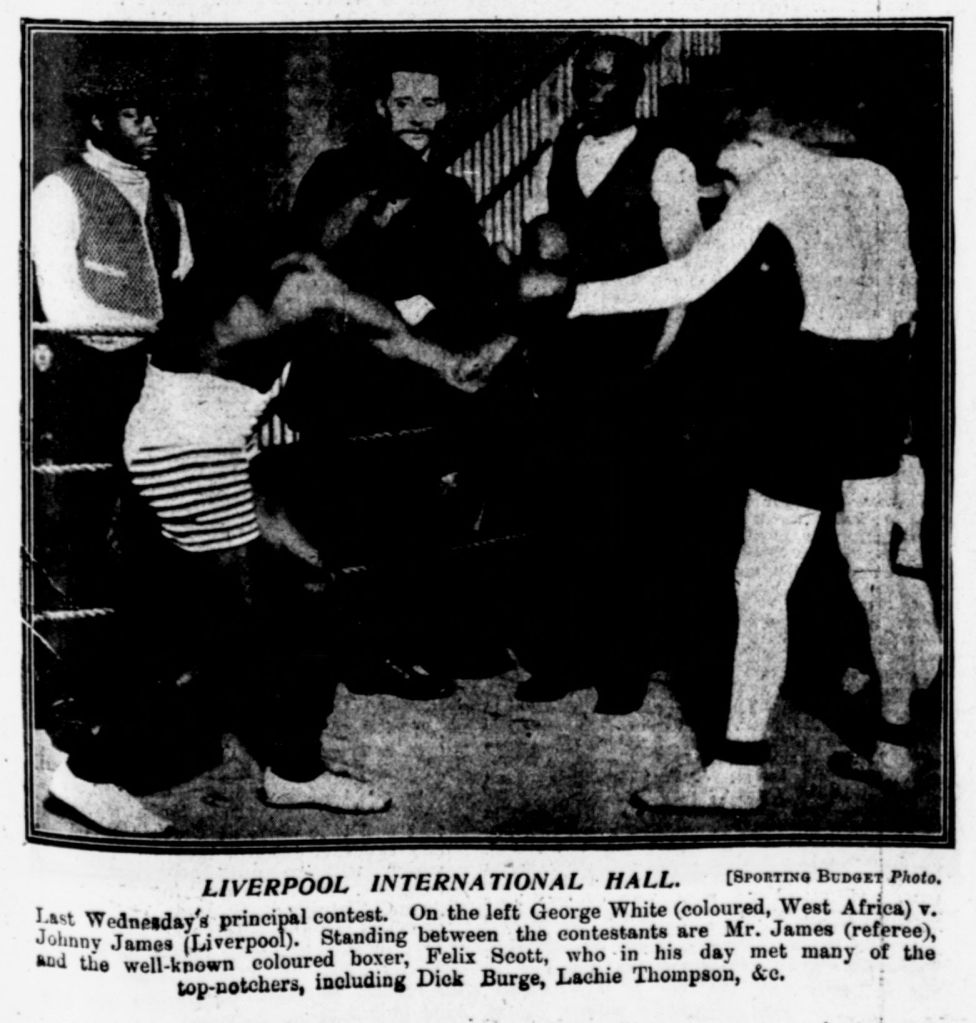
In brief, Scott’s story in Britain started with physical assaults on a girlfriend in the 1880s. Later, a fiancee in Wales gave birth to a son, also Felix, before the relationship then ended, and little Felix died as a baby. The older Felix was accused of physical assaults on his next fiancee and then wife, Lucy, in the late 1890s. In 1909 he was charged with “ill-treating” – I am not sure whether this means neglect, or abuse – his daughters with Lucy, Nada and Lilian, who were then aged nine and ten. He was sentenced to three months with hard labour and the children were removed.
In his last years of life, the 61-year-old Scott got into further trouble with the law over a relationship, the details of which I won’t go into here. While only reported in the local Wigan newspaper in 1918, it was far from a dignified end for someone well known in the area for setting up a boxing school and teaching young men.
Needless to say, when a great grandson of Felix Scott emailed me last year, and more recently a great great grandson who had just started to explore the family tree, I was extremely nervous to open their messages.
How on earth would I feel if someone had exposed these dark, pretty awful, events from the past if they were about MY great grandfather? What right do I have to go digging it all up? Would they be angry, insulted, and ask me what the hell I thought I was doing?
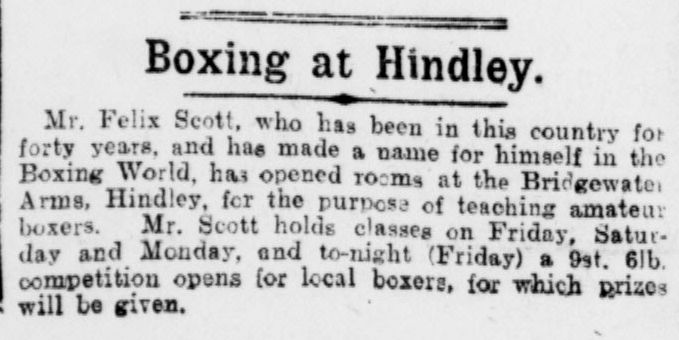
Luckily my interactions with both descendants have been really positive and also extremely positive for the future of my research into Scott and his family. Neither had known much, if anything, about him until reading my articles. But they did know more about their great grandmother and grandmother and the next generations.
I am incredibly grateful that my research has been met with excitement, with appreciation, and with an incredible tolerance and understanding that the truth is the truth and the past is the past and presenting Felix in all his glory AND gory detail is really the only right way to do it at all. He was no hero and can’t be presented as such.
One of them said to me recently: we were taught to always try and be better than the generation before us. I love that ethos and believe it is one that can, and should, be interpreted without necessarily insulting those of us who came before. We keep learning, growing, building, and changing and never accepting that a path laid for us is the one we have to walk down.
I will never treat Scott as a good man, I can’t celebrate him as such. But his life and that of his family is absolutely a fascinating one, and a part of British history, boxing history and entertainment history through which we can learn so much. He is also certainly no rarity among my research subjects in his treatment of women and girls. He just happened to make the newspapers with it a little more often than most.
It is through my interactions with his descendants recently that I have learned a lot too, and come to discover more about Felix Scott’s legacy.
And WHAT a legacy.
His daughter Nada, who looks to have been born in Bristol, England, and Lilian, born in Wales (although both would be later attributed as Bristol) were removed to an orphanage and trained for domestic service after their “ill-treatment” in 1909, but what happened to their mother, Lucy, who was white, and from Wales, was a mystery to me and I had feared the worst: she seemed to disappear from records.
Through her family I now know that Lucy and Felix parted ways and Lucy went on to marry another man and have more children. Nada and Lilian had a tough start and tough lives, then Lilian had a new start in America. Nada stayed in the UK and, like her mother, married a man from Barbados – some of their children would go on to move to the US too.
I cannot wait to find out more about them, and about Lucy: something that I don’t think would have been possible without their families’ help.
And then there’s Eric. Had I heard about Eric? Who’s Eric, I asked? Eric Scott Lynch, was an incredibly well known Black historian, trade unionist and Black rights activist born in Newington, Liverpool, in 1932. During his life, and in his obituaries in 2021, references were made to his having a Black British mother and a Barbadian father.
Well, it turns out that mother was Nada Scott. Eric was Felix and Lucy’s grandson.
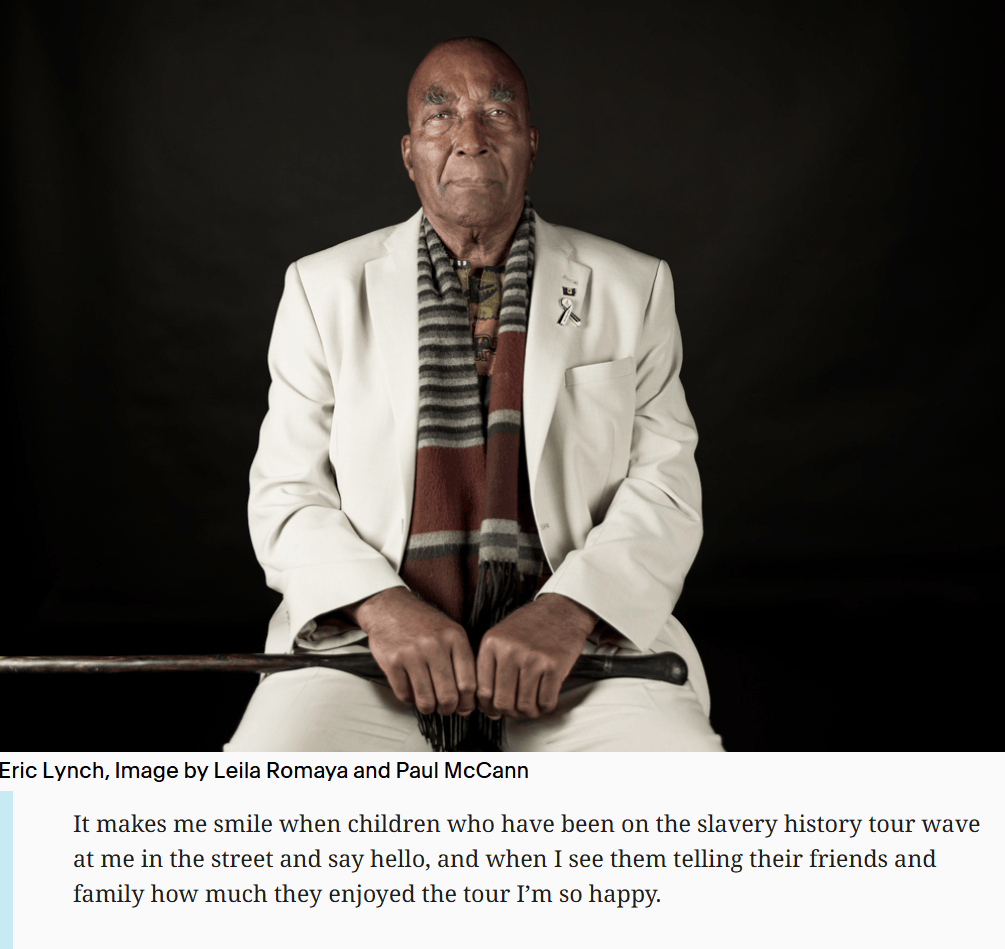
His obituary on the National Museums Liverpool website starts:
“Eric has encountered and fought against racism and inequality throughout his life. He was racially abused at birth by the White midwife who delivered him and he faced racism from both teachers and fellow pupils at school. Eric received a poor school education in Liverpool because of his colour and his working class origins. Despite being barely literate on leaving school, Eric was keen to educate himself and developed his interest in the history of Liverpool and in the welfare of working class people.”
Eric Scott Lynch worked in the building industry, and then for Liverpool City Council in roles related to health and safety and race equality. He was a public speaker, a campaigner who took part in countless meetings and marches for equal rights.
He started taking people on informal slavery history tours of Liverpool in the late 1970s, continuing this work more formally in the 1980s and ‘90s, eventually in conjunction with Liverpool Maritime Museum. Eric educated people young and old, in person and through media around the world.
I probably would have never known that he was Felix Scott’s grandson if it wasn’t for relatives reaching out.
Plans have been bubbling in the back of my mind for a while about a sequel of sorts to my forthcoming book, The Devils’ Dance Floor. I had been planning for it to focus entirely on two boxers: Felix Scott, and Albert Pearce, the latter an African-American cyclist, road-walker and baseball player who moved to Britain, became the first Black cyclist in British professional competitions, before turning to boxing and being blinded.
I’ve recently had a conversation with Pearce’s great great grandson too, and learned more about his wife Emma and their children, Lilian and William. That research is also ongoing.
Now I know much more about the next generations in both men’s families, it opens so many possibilities for a book that can follow twisting paths and incredible lives from the 1850s to present day. I’ve got a lot of reading to do about Liverpool’s Black history, visits to make, thoughts to think, phone calls to have, and archival research to be done.
In recent months I’ve been absolutely inundated with messages from descendants of men – and women – I have been researching over the past seven years, from Scott and Pearce to more of Jack Wannop’s great great grandchildren, to – and I can’t quite believe this – the great grandson of Alf ‘Nobler’ Fry, the Deptford greengrocer who owned Steve, the wrestling donkey!
It’s absolutely the best part of doing this work, and the biggest motivation to keep on doing it.
Thank you for visiting – there will be more blogs and some exciting news about THE DEVILS’ DANCE FLOOR coming soon.


Leave a Reply