If you were in your home on any street in Britain during the Victorian period, and you opened the window and yelled out “Oi! James, Anne, Mary Ann, come ‘ere!” two things would probably happen.
Firstly, you might get reported to your local Board of Guardians for being a bit weird and a menace. Especially if you said that some boxing historian from the future told you to do it.
Secondly, half the men in the borough and probably three quarters of women would be on your doorstep.
Basically, these three names were very, very, common, and are now very, very annoying for historians and genealogists. Especially when paired with the surname Smith.
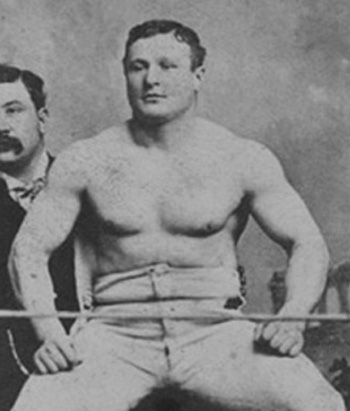
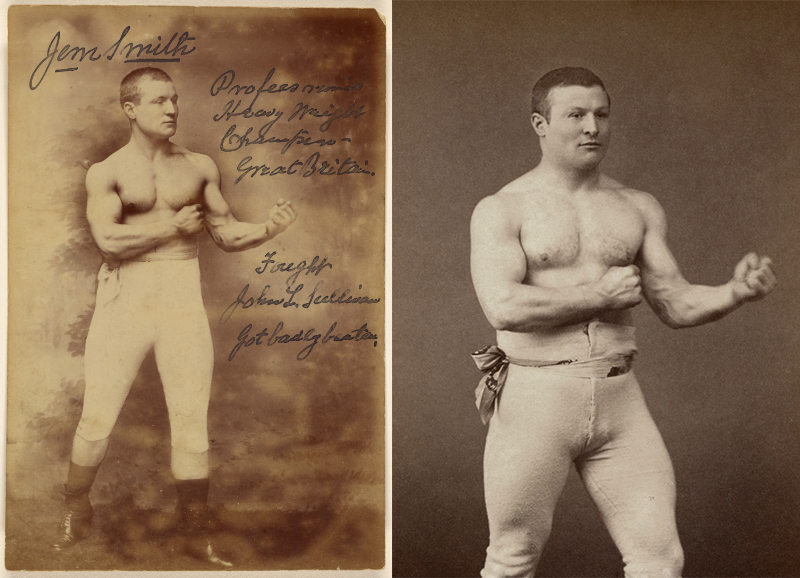
The Heavyweight Champion of Britain from the mid 1880s to 1891 (and then again for a later stint) was a half-Irish, half-Scottish Englishman named James Smith, who was usually known as Jem, and sometimes Jim.
A chapter in my forthcoming book looks, in far too little detail, sadly, at the rise and fall of the last bareknuckle champion’s career, and how his big matches with fistic celebrities like Peter Jackson and Frank Slavin contributed toward bringing forth the last days of the the old style of fighting, and the start of the Queensberry Rules era.
Due to both a restrictive word count, and the fact he had a comically common name that is a nightmare to research, I’ve not been able to include too much information about Jem’s personal life. The story I’m presenting in this post is only touched upon in the book’s final chapter.
Jem Smith died in 1931, aged 68, having suffered from ‘a long illness’. He had been born in St Luke’s, but spent many decades living in Willesden in a smart but modest terraced house (it’s worth a lot today, but only by virtue of being in north London) and was buried in Willesden New Cemetery. It was not until 1934 that he was afforded a headstone by surviving friends.
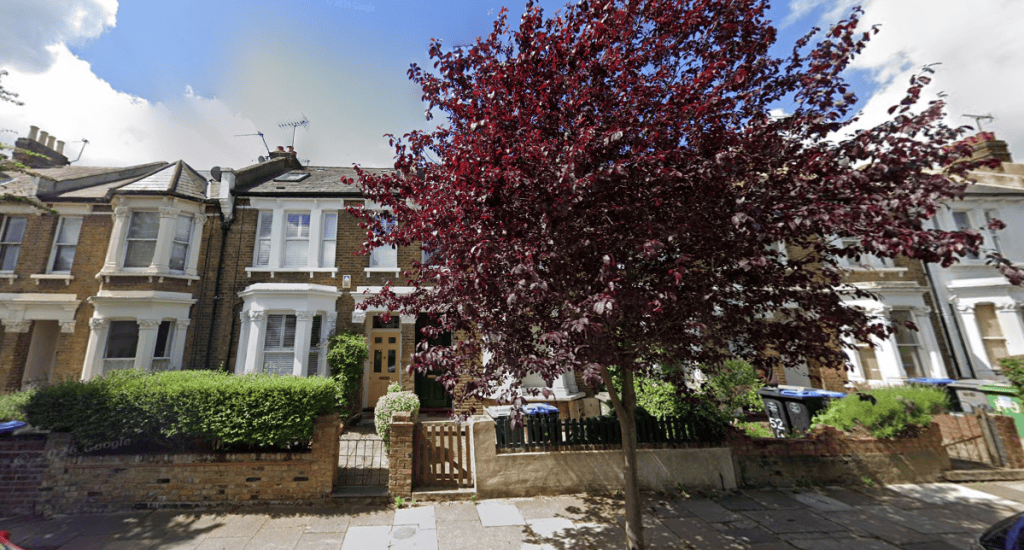
Jem Smith had long evaded me on the 1891 and 1901 censuses, but after finding out Smith had moved to Willesden as a young man, he was easier to find with the very generous help of Scottish sports historian Andy Mitchell. And there was his wife’s name on these censuses too – Mary Ann Smith.
On the 1891 census, which was taken shortly after Smith lost his title to Ted Pritchard with the gloves at Wannop’s Gymnasium in New Cross, he was living at 48 Torbay Road, Willesden, and gave his job title as Professional Boxing Instructor. The 28-year-old was married to ‘MA Smith’ and they had a three-year-old son, also James. Martha Clark, 25, who was possibly a sister or friend to 26-year-old Mary Ann (the pair were both from Bethnal Green), was visiting. The Smiths also had a house girl called Susan Clarke, 14.
A decade later, and the Smiths – Jem now a commission agent, a job he would do for many years after his boxing heyday, while growing increasingly rotund and occasionally performing exhibition matches – were still resident at 48 Torbay Road. The house girl was gone, and little James was dead.
By their mid 40s, the Smiths had not moved. They were still at 48 Torbay Road in 1911 yet, strangely, Mary Ann’s relationship to the head of house, Jem, is given as housekeeper, not wife. Charming! She has ‘housekeeper’ in both her relationship column and her occupation column, so it’s probable there was a mistake here: they are clearly stated as having been married for 25 years (so married around 1886).
Little James is confirmed, in that dreaded, miserable ‘Children who have Died’ column as no more.
Four years after the 1911 census, when James Smith and Mary Ann Smith had been married almost 30 years, newspapers across the country reported that the former Heavyweight Champion’s wife was dead.
Which might have been rather shocking news to Mary Ann, if she had picked up a paper that morning. She was very much alive (and would be for another 15 years), sitting in her parlour on Torbay Road.
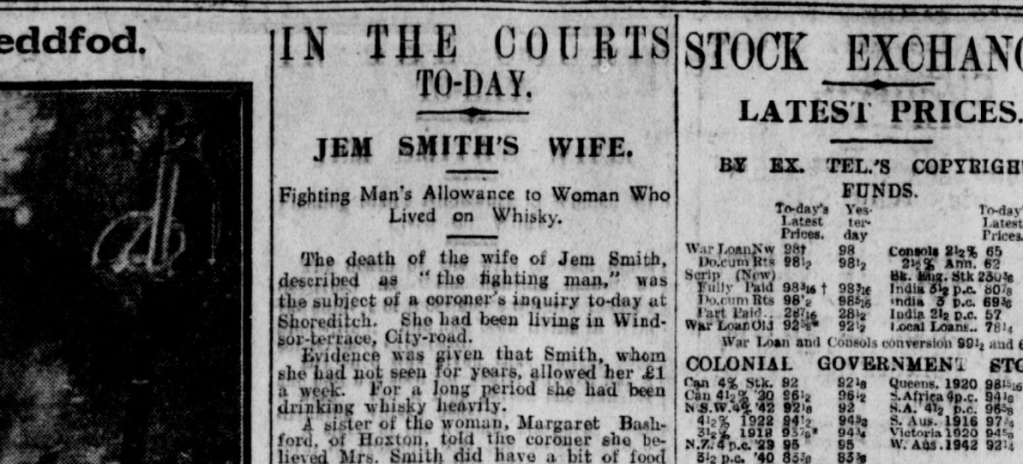
One headline, in the London Evening News, read: Fighting Man’s Allowance to Woman Who Lived on Whisky.
It is a strange and sad story, a story which has gaps and questions that I am still trying to solve.
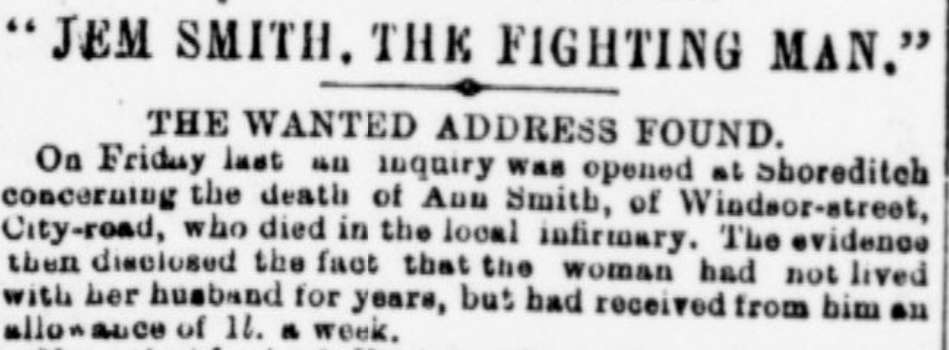
A woman by the name of Ann or Anne Smith died in early August 1915 at the Shoreditch Infirmary from the effects of “chronic alcoholism” and dropsy. She was 53.
It would have been an unremarkable death, unlikely to have been reported on across the country if it were not for her connection to Jem, which emerged at the inquest.
Anne’s sister Margaret Bashford attended the inquest in Shoreditch and stated in court that Anne was the wife “of the fighting man Jem Smith” and she had long been receiving £1 per week from him, which she spent on drink. She “had a bit of food now and again”. Just before Christmas 1914, Anne had a fall, and had since gone from bad to worse.
A doctor said that Anne, at the time of her death, was bruised from head to foot owing to falls when she was drunk.
For all the commonality of her name, Anne Smith is fairly easy to find on the 1911 census. Her 1915 address is reported in some of the newspaper coverage of the inquest as Windsor Terrace on City Road, and sometimes as Windsor Street. On the 1911 we find an Anne Smith, then 49, living at 24 Windsor Terrace off City Road in Shoreditch. She had been born in St Lukes, the same place as Jem, the year before him.
There is no one else listed as living with her, she was alone, but according to her marital status column she was married, and had been for 30 years – since 1881. She had no children, had never had children, and there is just a line drawn in the work related columns.
Other reports give Anne’s address at the time of her death as ‘Provost Place, Hoxton’, not Windsor Terrace. Provost Place was a pioneering social housing scheme, built in 1890 on the corner of what is now Provost Street and Nile Street. Windsor Terrace – residence of Mr Micawber in Dickens’ David Copperfield, as an aside – was just round the corner.
Margaret Bashford told the court that Jem Smith was Anne’s husband, and he had been supporting her financially for a very long time. But for some reason, Margaret refused to tell the coroner, Dr Wynn Westcott, where Jem Smith lived.
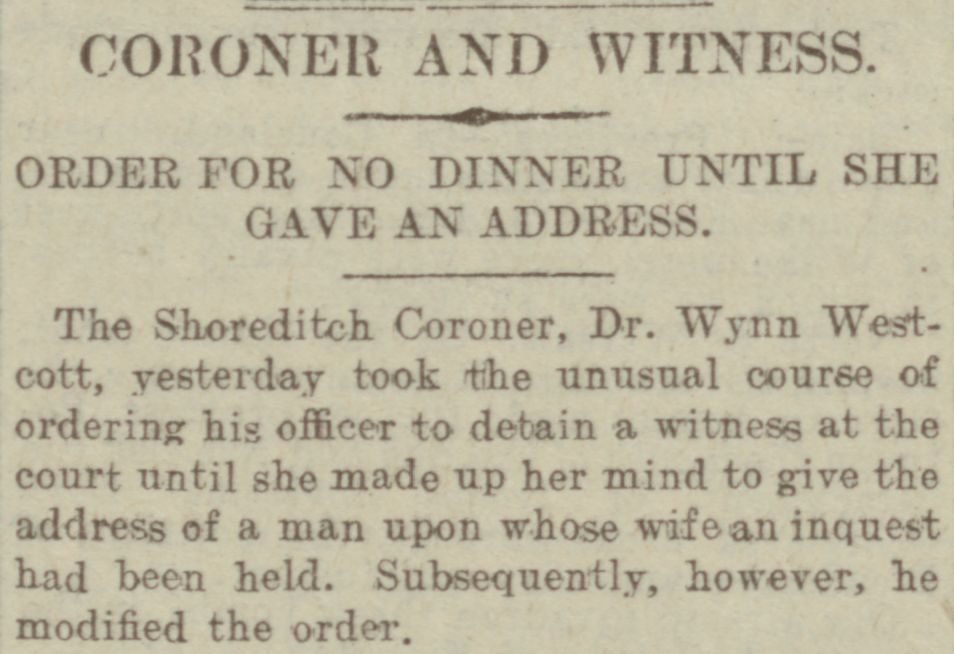
Westcott said he had reason to believe that Bashford did know the address, but was withholding it, and he detained her for a while – telling her she would not get any dinner if she did not give up the information – and threatened her with imprisonment. He made her return to court the following day, but by that time had acquired the Torbay Road address from somewhere else.
Why would Margaret want to keep Jem Smith’s address a secret? The coroner wanted to let Jem know that Anne was dead, both because that’s the sort of thing he should probably know about, but presumably also because he could then stop sending the weekly £1.
I’m not sure what Margaret’s play was here. Did she think that if he did not know, he would keep sending the money and perhaps she could access it? Or perhaps, contrary to the coroner’s impression, Margaret was telling the truth and she did not actually know the address.
Margaret told the court that Jem and Anne had been married for some 34 years – which would have put their marriage at around 1881 when they were in their late-teens – but they had “been parted for a long time” and she (Margaret, but we do not know about Anne) had not seen him for 23 years.
If Jem had been married to Mary Ann since at least 1886, as per the information on their censuses, and their son James was born in 1888, then Jem and Anne couldn’t have been married for long.
One or two of the articles published on the inquest note that Anne had “lost all her children to death”, insinuating that between her grief and not seeing her husband for a long time, this is what led her to drink. This fact is not in most of the short articles, however, and does not match the 1911 census, which says that the Anne Smith in Windsor Terrace never had any children.
Unless that was wrong? Possibly the wrong Anne Smith, or the right Anne Smith, and the wrong information. She might have married Jem very young, given birth to several children in quick succession, and lost them all. Or had them later in life and Smith was not the father?
I have found little else out about Anne – her birth, her family, her life. There are simply rather a lot of Anne Smiths. What did she do with her life from the 1880s onward? Did she work, or live off Jem’s allowance? I wonder if she was ever officially divorced from Jem, and thus whether Mary Ann was actually legally married to him afterward? Did Mary Ann know about Anne? Did she know about the £1 a week?
Did Anne and Jem have children who died, only for Jem and Mary Ann to then lose their son too? He was a celebrity, the heavyweight champion, but – as was typical – there was never a sign of the personal in his sporting interviews, during the peak of his career, the years after, nor in the brief obituaries published upon his death. Not in any I’ve managed to find to date, anyway.
I have been unable to confirm where Ann or Anne Smith was laid to rest after her death at Shoreditch Infirmary in August 1915. There are only a handful of records in the Deceased Online database for London in 1915 for Ann and Anne Smiths, including an Annie Bridget Smith who was buried in Southwark in August, but no certainty this was her.
My enormous thanks to the researchers who got in touch to help answer some of the questions above and fill in gaps – 24 hours after posting this article, we are almost there, some mysteries are solved! A part two to this post will be coming soon…


Leave a Reply