I was recently asked whether there were any Gypsies or Travellers among the boxers and wrestlers I’ve researched, or otherwise know of, who were active in the 1880s and ’90s. Boxing has long been a massive part of Gypsy and Traveller community and culture, so it surprised me that I couldn’t think of anyone straight away.
There was Jem ‘The Gypsy’ Mace, of course, a champion of the 1850s and ‘60s who was very much still around and still boxing in the 1880s, and long beyond them. I’m no Mace expert, but understand he always denied having Romani heritage.
My first thought was, well, how would I know?
Centuries of punitive and restrictive laws and persecution made it unlikely that any boxer in the 1880s who might have had a Gypsy or Traveller background would go around shouting about it.
Fight listings and reports gave a pugilist’s home borough or town if they were white, just ‘black’ if they were black (not helpful), or perhaps a country of origin if a fighter was white and from overseas. East London’s Jewish boxers might sometimes be guessed at by their surnames. Longer biographies published in newspapers ahead of or after a match of significance might elaborate but were rarely particularly detailed.
And while the US census had its first column for ethnicity in 1790, shockingly the UK only started asking for ethnicity data in 1991. It was not until 2011 that you could tick ‘Gypsy or Irish Traveller’ if it applied.
Then of course there’s the matter of not all travelling or nomadic people being from distinct ethnic groups, anyway, but defined instead by their history and culture – Showmen and Boaters among them.
Which is when I remembered Alf Ball.
Ball’s been written on before. A 2015 biography on the University of Sheffield’s National Fairground and Circus Archive gives us some details on his father, brothers, wife and son, and briefly mentions Alf’s career as a boxing booth proprietor. It quickly gets to the late-1890s and early 1900s activity for which he is remembered: Ball was a travelling Bioscope presenter who exhibited moving pictures. He’s remembered as a pioneer of early cinema.
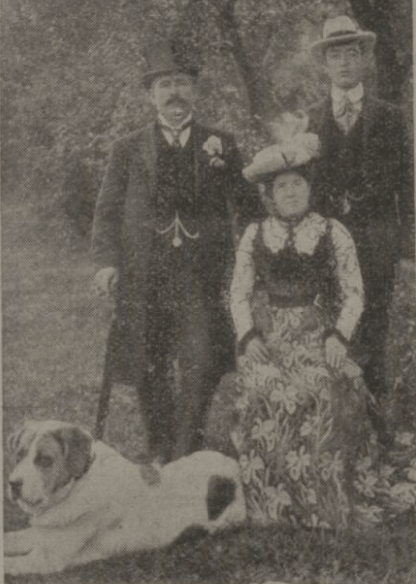
Michael Eagleton wrote on the ‘greatest showman’ Professor Alf Ball for the Bucks Free Press in 2021 for a feature about the history of cinema in the town of Marlow, where Alf Ball & Sons ‘Lyceum Bioscope’ was stationed for a time. The Ball Bioscope show gets a nod in this history of media, culture and cinema; in a 1994 journal article by Vanessa Toulmin titled ‘The Story of the Fairground Bioscope Shows and the Showmen Who Operated Them; and in many more online or journal articles on travelling fairground and early cinema history.
Coincidentally, I first came across him while living and working close to Deptford, where Ball was based at the fairground for many years. I’m now 80 miles away in Clacton-on-Sea, just a short walk from where his great great grandsons Billy and Elliott own and manage the pier and its fairground attractions. Billy spoke to Planet Radio about his ancestor in 2021.
I’m unfortunately no longer affiliated to a university as a staff member or student, which means my access to some resources, such as academic journals, is now restricted. But through my currently-available extensive research methods (‘doing a Google’), we can see that while Ball’s Bioscope has been remembered, it doesn’t appear that his boxing years have been sucked out of the newspaper archives, patched together and chronicled.
What of Ball the boxer and boxing promoter? What about the bit where he challenged Peter Jackson or took on Alf Mitchell over 64 rounds with the raw ‘uns, nine of those with a broken arm, out in the marshes of Kent?
Let’s do that part. Here’s Chapter I of II.
Alfred Ball was born near Hull in 1864, the son of William and Fanny Ball (no giggling at the back, there) and a younger brother to Joseph, John Henry and Elijah. All four younger Balls were born in different places – you’ll find this a lot on census records for travelling families. In 1871 they appear on the census as living in a van on a farm in Crowland, Lincolnshire. 51-year old William was a travelling auctioneer, a career John Henry initially followed him into. William’s occupation is illegible on the 1871 census, but written across the side is the word ‘Hawker’.
I’ve struggled to find Alf on the 1881 census and would, as always, welcome help from readers in locating him. There are numerous teenage Alfred Balls lodging in a variety of locations. But John Henry is easy to find, living with wife Emily and daughter Prudence among the families in ‘Travelling Vans’ and ‘Hawker’s Vans’ on Cobbold Road, Wanstead – a path leading to a historic stopping place on Wanstead Flats at the southern end of Epping Forest. There appears to be just a handful of travelling families living on the site at the time, the majority with the surname Smith, plus some Gaskins. Fathers and older sons were listed as Hawkers and Labourers.
We’ll return to Wanstead Flats in Part II of this article, as we find Alf there in 1891 among five more pages of Showmen families based on the by-then much busier site.
According to a feature on Alf published by The Era in 1906, at 18 he joined his father in his line of business, and held his own licence as a travelling auctioneer. He worked the Midlands and southern markets and fairs before “like many a showman, on his marriage he was set up in business by his parents”. Alf and Elizabeth, known as Lily Ball, became the young owners of a touring shooting gallery before branching into throwing games and a boxing booth, or Prof Ball’s School of Boxers.
Already an amateur boxer of some repute, following “a friendly scrap with a professional at a boxing tournament” Ball “so astonished the crowd” that “he was acclaimed a splendid possibility for the middleweight championship of England”, said The Era.
By the late 1880s Alf as a boxer is usually referred to as a resident of Deptford, south east London. A December 1887 write-up of the Professional Boxing Association’s well-attended meeting at its head-quarters, the Blue Anchor, Shoreditch, noted that Alf was a member and that a benefit for him was due to be held in the near future at Deptford’s Lecturer Hall, a popular boxing venue on the High Street. Several members promised their support.
The same week a catch-weight competition for black boxers fighting for “a purse of gold” was held at the Red Lion, Red Lion Court, Fleet Street. Organised by the pub’s boxing instructor Sergeant Green, the event struggled to attract entrants. According to the Sporting Life, it also struggled to attract a crowd, “owing probably to the higher tariff charged for admission”. With only Glasgow’s Stewart, Liverpool’s Scott and London’s Ching Hook (otherwise known as Hezekiah Moscow) showing up, Alf Ball – who was not black – took on Scott in a “spirited” first round bout. The final between Hook and the much heavier Scott was declared a draw.
Ball entered a contest at Tom Symonds’ celebrated East End saloon early in 1888, going six rounds with Jem Burchell in a “slogging” contest to wind up the night. With “fast and furious fighting taking place throughout”, referee Mr Angle had to call out more than once for the fighters to break a hold. In the early seconds of the final round the pair collided so heavily that Ball’s left eye split open on impact with Burchell’s skull, claret flowing freely. “Both were dead beaten by the end” but Ball was returned the winner.
In the first of several matches to come, Ball met with Alf Mitchell of Cardiff (“two splendidly made fellows”) at Tom Symonds’ in February for a six round exhibition, and it is around the same time that Ball’s adverts for his own competitions at his boxing pavilion at Deptford – part of the fairground – began to appear in sporting newspapers.
It is possible that if Ball wasn’t with family in Wanstead during this time and his hometown is given as Deptford during these years, he may have lived on-site at the fairground alongside his boxing booth.
Alongside Mitchell and 15 other men, in March Ball entered into the top weight class beneath the catchweights (10st 12) at Ben Hyam’s grand boxing tournament at the Royal Agricultural Hall, to be held on 9 April. But along with Bill Goode, Ball ended up overweight and unable to participate.
In May he posted in the Sporting Life offering to fight a man called Tom Lees at 11st 4lb or catch-weight, 10 or 12 rounds, Queensberry Rules, since Lees hadn’t managed to attract any other responses to his challenges. Ball doesn’t appear to have received a reply.
Ball continued to appear in listings for sparring and assaults-at-arms in the East End across 1888. He committed to box at the Professional Boxing Association’s fourth annual assault at arms at the Forester’s Palace of Varieties, Mile End, and exhibited at the Lillie Concert Hall, Lillie Bridge alongside all the usual names – Alf Mitchell and Ching Hook among them.
In a Grand Assault at Arms at Her Majesty’s Theatre, Haymarket, in December 1888, Alf Ball (Deptford) was matched with Mike Jennett (Leicester) as part of the night’s catch-weight professional competition. Jennett, the taller but lighter man, was “particularly lively on his feet”, landing more blows than Ball but with less force. In the second round of six, Ball – who was not quite fully healed from a recent injury to his arm – hit Jennett with such force under the ribs, followed with one on the jaw, that Jennett was knocked down to the stage, where he lay motionless until the ten-count. Ball was declared the winner just a minute and 30 seconds into round two.
Having reached the semi final on the competition’s fifth day, Ball’s ongoing arm injury forced him to drop out. Ted Burchell of Shoreditch beat Alf Mitchell – who by this time had moved from Cardiff to Kingsland, London – for the prize.
Ball had become well acquainted with the black American heavyweight Jem Haines, who was based in Bristol before moving to London to fight and, on occasion, manage Ball’s Deptford boxing booth. Alf seconded Haines in his January 1889 match with Mike Moore of Lambeth. Originally set for eight rounds, Moore was declared the victor after two. Haines has been one of my favourite ‘forgotten’ boxers to research – you can read his two-part biography here.
Ball engaged in an exhibition match against an amateur called Day in February 1889 at the Theatre Royal, Stratford. A benefit held in honour of two ladies taking part in the theatre’s pantomime (Cinderella), Miss Ada Terry and Miss Florence May, featured numerous appearances by boxers among its “ordinary programme”, among them Jem Mace and his cousin Pooley. At the Slough Public Hall the same month, Ball sparred with Mr Mace in the wind-up.
Ball stepped into the ring with Mitchell again the following week in the 11st 6lb category at Frank Hinde’s Second Grand Boxing Tournament at the Aquarium Theatre, London. He also found time to gather with the top tier of London’s pugilists for a benefit at Ye Olde Cheshire off Fleet Street in honour of Ted Pritchard, the future English heavyweight champion.
The Mitchell and Ball saga came to a head in April 1889 as the two met to fight bare fist, London Prize Ring Rules, out in a secluded Kent field, for £200 or £150 depending which newspaper you read.
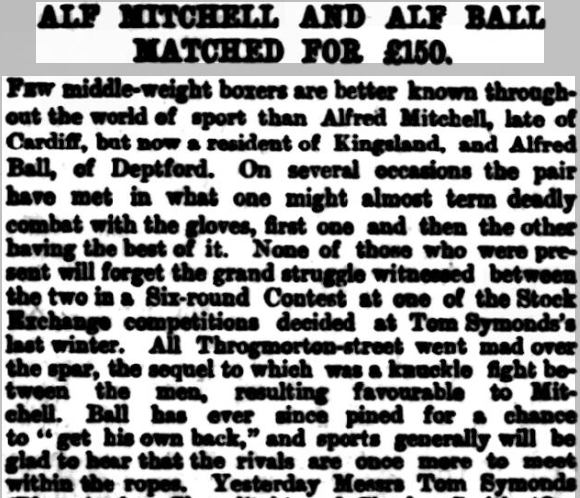
Described as “one of the most determined prize fights that has taken place between middleweights in the London district for a considerable time” by the press, the match was pulled off in the early hours of the morning inside an “excellent ring” in front of a crowd of 50 and with no interference from the police.
The Echo reported:
“Both combatants are well known in fistic circles, and have met several times in boxing competitions without any definite result being arrived at as each in turn has been declared the winner… each man has been in training for several weeks, Mitchell having been sojourning at Newmarket, and Ball at Southend.”
Alf Mitchell weighed in at 10st 12lb, with the slightly taller Ball coming in a few pounds heavier. Ball was attended by his brother Elijah and Dan M’Ganon while Mitchell’s seconds were Dick Roberts and Jack Hicks, his trainer.
The pair stripped and half an hour of fighting of “a very fierce description” ensued, neither man gaining any clear advantage. The action soon slowed and “the heavy marks of punishment were visible on both, particularly around the face”.
As the 55th round begun, Ball had the misfortune to break “a small bone in his arm”. Being a Victorian prizefighter and all, he pluckily persevered for another nine rounds, but with Mitchell clearly having the best of it. Ball finally called out “hold, enough” and the party quickly dispersed and made their way back into town. Regional newspapers up and down the country carried a report of the Great Prize Fight with nature’s weapons.
Neither man was in any shape to compete at Ben Hyam’s Grand Boxing Tournament a couple of days later, but both were pulled into the ring to be introduced and received roaring applause from the crowd.
On Friday 26 April, Ball popped down to Hove and hung out with his old friend, the English heavyweight champion Jem Smith, who was recovering from a nasty injury to his foot, and a month later a benefit at the Paragon, Mile End, was held to support Ball in his recovery. It promised to be “one of the greatest shows of the season” with all lovers of the sport encouraged to show up and enjoy “a rare Tom Cribb’s parlour scene” with “all notable boxers” lending their assistance. Ball had recovered by summer and was back as a regular on the East End pub sparring scene.
Coming soon in Part II: Professor Alf Ball introduces us to the Muscular Maids from Mexico, the Sisters Mills, and introduces himself to the black champion Peter Jackson.


Leave a Reply