On Tuesday 4th August 1891, the Sunderland Daily Echo and Shipping Gazette published a short article titled A Disappointed Lady, which I will publish here in its entirety. The piece does not appear to have broken out of the local area and onto the newswires. It was not published elsewhere. What happens in Sunderland, stays in Sunderland.
Ellen Birch’s story starts out quite funny, and ends up anything but.
A DISAPPOINTED LADY
At the Borough Police Court yesterday, before Robert Thompson, Ellen or Esther Beck was brought up charged with two assaults. Prisoner, who follows the calling of a lady boxer, on entering the dock, attracted general attraction by her herculean frame.
Turning to Mr Elliot, Police Court fees clerk, she struck him across the head, saying “Look at yer book, you b——, and not at me.” During the hearing of the whole charge she kept up an incessant volley of oaths, and drew forth the laughter of the court by her reference to the characteristics of the different justices.
The evidence showed that she entered the Salt Grass Inn at Deptford on Saturday and called for drink. Mrs Collum, the landlady, refused to serve her, called for the police in order to have her put out. Before P.C. Spence arrived prisoner assaulted her, and also on getting into the street insulted a lady named Armstrong passing by.
The Bench committed her to gaol for two months, prisoner remarking as she left the dock “Oh, you —, is that all. I thowt I was in for a twelver.”
As ‘Ellen Beck’, she had priors. The UK Calendar of Prisoners shows her to have served a month in Durham prison back in 1886 for stealing £1 and 10 shillings, and she was three times imprisoned (including the sentence given above) for assault, and twice for drunkenness.
The Calendar also suggests that Ellen or Esther Beck’s real name was Ellen Birch, and she was 29 when sentenced in 1891.
Ellen was not wholly unique in following the profession of Lady Boxer in 1891. The Sisters Mills – two Black or Black mixed heritage women – had been travelling with Alf Ball and his boxing booth since 1888 and there were a number of music hall ‘champion lady boxers’ drawing crowds, including Rosie Danvers, Selina Seaforth and Alice Daultry. Seaforth and Daultry performed with rival brothers’ acts, Daultry also touring with Professor Ching Hook (aka Hezekiah Moscow) around the UK from 1890. Maude Pearce, the Sisters North (daughters of travelling showman Charles North) and Mrs Noon – wife of Billy Noon – from Birmingham were among those on the lady boxing scene.
While there were several others touring England with rival boxing booths to Alf Balls, many women boxers in 1890-91 could more accurately be described as music hall comediennes and serios, turning their hands to boxing-themed sketches. Even Alf’s ladies were not ‘competitive’ boxers as such, they sparred with each other but he would not allow them to fight against others, male or female.
A penny-show purveyor by the name of John Eaten had female boxers in his troop in 1891 (he was described as a “penny show nuisance” in court when charged with blocking the pavement), and in 1890 a Miss Lottie Barnes – champion female boxer – was at the fairs in Oxfordshire with a one-eyed man, a boy, and a powerfully-built bloke, who wasn’t Alf Ball because he was with his boxing booth, and his ladies, stationed just down the road.
There was no epidemic of women boxing, as such, but it was certainly growing in popularity.
Although… a press panic occurred in 1890 as if it WAS an epidemic, with male medical professionals writing in the country’s oldest medical journal, The Lancet, raising concerns about Lady Boxers and Lady Cricketers.
The American girls were largely to blame for the increased interest in boxing, apparently. But on “health grounds”, such things should not be encouraged – the “manly art” should remain an exercise for the development of male muscular powers and agility, only. Ladies are recommended to be content with other games and methods of physical improvement. Hah, okay.
I do not know where Ellen Beck, or Birch, boxed, or with whom. I cannot even say that her real name was definitely Ellen Birch, and even if it was, whether that was the name she boxed under. There is no sign of her, that I have found, under the name of Ms. Ellen Birch, or the Esther and Beck aliases in connection with boxing, in the Sunderland region or elsewhere, in the late 1880s or 1890-91. As always, please get in touch if you come across anything relevant.
We can find, however, references to unnamed lady boxers which might, perhaps, have included her. The Leicester Chronicle in October 1889 mentions a troop of “champion lady boxers” at the Humberstone Gate Pleasure Fair, for example, noting that the boxing booths were extremely popular with the public (the performing fleas, less so). Stockton Hiring Fair – which is in County Durham – had female boxers from at least 1889.
Almost as soon as Ellen was released from prison after serving two months for the assault on Mrs Collum, she got drunk at another pub and tried to rob a man of his watch and chain.
On the 23rd October 1891, the Sunderland Daily Echo, under the headline of A FEMALE BOXER, reported from the Borough Police Court that Ellen Birch, alias Gibson, alias Beck was charged with stealing a watch from a man named William Waddell.
Waddell, a travelling salesman for a brewery, entered the Ship Inn on business. Ellen Birch, who was said to be under the influence of drink, approached him and snatched at his watch and chain, causing the two to scuffle. In the course of it, the watch and chain disappeared. A woman by the surname of O’Neill later found it buried in the sawdust on the floor.
Birch, who was said to be known as “the champion lady boxer” (as were most of the women I have mentioned above between the late 1880s and early 1890s) spent the entire hearing in front of the Mayor (Mr Shadforth) pouring a torrent of abuse at Waddell, the witnesses and the Bench.
On being sharply removed from the dock at the initial hearing, she squared up and landed a heavy blow to the face of the police officer attempting to detain her.
Ellen Birch was quite the, erm, character.
Given her behaviour both in the pub and in court, it sounds like she would have got her “twelver” on this occasion. And yet, the criminal record shows that the case was dismissed in January 1892: Ellen could not be committed to trial, because on the 2nd of November 1891, she had been removed to Sedgefield Asylum in Durham.
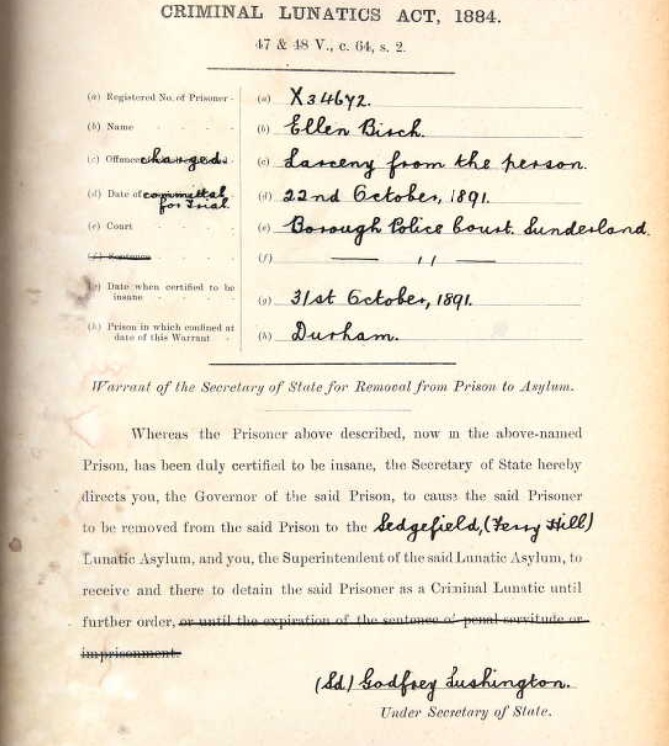
Ellen’s warrant of removal from Durham Prison to Sedgefield Asylum (which had originally opened as Durham County Lunatic Asylum in 1858 and later went by other names) is available online but it gives no detail at all of the reasoning for her admission, her appearance or health condition, or much else.
Her prison registration number is given as X346Y2, her name as Ellen Birch, and her crime as ‘larceny from the person’, the date of the trial being 22nd October 1891 at Borough Police Court, Sunderland. She was certified insane on the 31st October while being held at Durham Prison. The warrant states that she was removed to Sedgefield (Terry Hill) Lunatic Asylum, under the direction of Godfrey Lushington, Under Secretary of State.
There is little else currently available to me online, except for her entry on the Lunacy Patients Admissions Register. It shows that an Ellen Birch was admitted to an asylum at Durham on the 4th November 1891. In the column titled Date of Discharge or Death it gives the date 31 December 1891. The column for Death is ticked.
Ellen Birch, the funny, herculean, gobby, menace, just 29 years old, died less than two months after being admitted to her local asylum. She can be found on the UK’s death register for the first quarter of 1892.
We know that a wave of ‘Russian flu’ – a global influenza outbreak which had started in 1889 – hit Britain hard in 1891, but this is simply speculation. Conditions in the hospital at the time would have been ripe for countless diseases to have killed Ellen, or maybe it was down to something else entirely.
Was 29-year-old Ellen Birch a mother? Married? Who were her parents? Where did she perform as a lady boxer? Just how Herculean was her stature? What was the cause of her drinking, her stealing, and her utter disgust for authority and rules? How did she die?
There are Ellen Birches born around 1863 on baptism records, censuses, Ellen Birches arrested in different places in the 1880s and Ellen Birches who married lads called James. There are a good handful of Ellen Birches on the 1891 census around the country, born between 1861-1864, but none with a profession given or a location that suggests it might be her. It’d be pretty funny if she’d had ‘Lady Boxer’ put down anyway. I don’t know if any of these Ellen Birches are Ellen Birch, lady boxer, dead in asylum at 29, because we can’t say for sure if her name was even, really, Ellen Birch.
There are more questions here than answers, when it comes to Ellen Birch. I was taken with her story because we’ve all seen her – born in the early 1860s – in the 2020s. I’ve seen her in London, and in the North. I’ve seen her gobby mouth and hatred of authority in friends and a little in myself after too many glasses of wine. She did some bad stuff that 1891 couldn’t cope with, and then she was dead at 29. She didn’t deserve to be. But I do think she deserves to be remembered, for these very reasons.
 Rediscovering the wrestlers and boxers of Late-Victorian London
Leave a comment