A year and a half out of the ring, “absent from public view”, had taken its toll on Felix Scott.
After getting out of prison and getting just a week’s training in, on 18 February 1890 Scott entered the ring with a 22-year-old 11st 4lb John L. O’Brien of Cardiff for a £50 purse at the Lyceum Theatre in Liverpool.
The match with small gloves started well, but by the second round the 10st 4lb 30-year-old Scott (according to the newspapers, anyway, he was 33 by my count) was being battered around “like a ninepin”.
The third round came to an abrupt conclusion – the “Irish Welshman administering such severe punishment that Scott was knocked out before time was called”. It was a disappointing return, but Scott picked up the loser’s purse of £10 for his troubles. The following week it emerged that within seconds of the fight’s start O’Brien had hit Scott in the head so hard he had broken a bone in his left arm. A notice appeared in the Sporting Life to let everyone know that O’Brien was in a splint and would be out of action for six months.
Please be aware that this article contains language quoted or screenshotted from Victorian newspapers which is considered offensive today. It also contains descriptions of male on female violence. You can read Part I of Felix Scott’s story here.
A benefit was held for Scott at the end of February, again at Liverpool’s Lyceum Theatre, with many in the local boxing community rallying around their returning ‘champion’, yet with little to show for it in fundraising. He threw himself enthusiastically into challenging anyone and everyone around 10st, hoping to make up for lost time and cash prizes. In April, Scott posted in the Sporting Life that he would take on any challenger “no one barred, black or white” if the Ormonde or Pelican Club in London would provide a purse. He was particularly keen on Charlie Bartlett or Bartley (Meat Market Charlie), or Jack Davenport if the money was right. “Business only meant, first come, first served”. The Black American Albert Pearce of Newcastle – who was not to go blind for another three years – raised his hand.
Scott had returned to form by June. Over a night of boxing at Manchester’s Grand Circus, Scott versus Tom Shawcross of Manchester fighting eight rounds for £10 was considered the most exciting match of the evening, Scott from the start “proving himself to be the better man” according to the Yorkshire Post. “[He] landed on his opponent’s face several fierce and heavy blows. Not many seconds after the commencement of the second round Shawcross was lifted off his feet and lay half conscious in the ring.”
An inspector with the Manchester Police rushed in, calling a halt to the match, and Scott was announced as the winner by the referee to hooting and hollering from the crowd. “The fairness of the conclusion was obvious to those who had been near enough to watch the fight closely,” acknowledged the local paper. Writing in the Sporting Life, ‘Shawcross’ immediately demanded a rematch for July. A couple of days later a notice appeared from the real Shawcross to say he knew nothing about that request – someone else must have posted it, and he was laid up with a broken arm (making him at least the second man to break an arm on Scott’s head in a couple of months). Albert Pearce spotted the notice and suggested he and Scott “have some fun” with small gloves instead.
Scott continued to ignore Pearce and continued to box across the north of England with a touring boxing company, sparring on a bill headlined by the Sisters North – two lady boxers – in the small Northumberland village of Seaton Delaval in November 1890.
He came back to London “fit and well” in December, returning to the Pelican Club for a match with Alf Bowman in which Scott had “the ferocity of a madman”. “His terrible looks seem to frighten Bowman,” noted the Sporting Life, while also suggesting that Scott had a “dreadfully distorted face”. A week later, in a report of another event at Bill Natty’s Hop and Malt School of Arms, they referred to him as the “modern Molineaux” – a perhaps more flattering reference to Tom, the Black English champion of the early 1800s. The descriptions of Scott’s appearance here are not referencing any actual physical deformity. There are no other mentions of anything like that to be found, but we can find a much later mention of Scott having notoriously ferocious “grimaces”. Here, in the early 1890s, there also seems to be a rise in racist language and phrasing used in the Sporting Life’s coverage when it comes to Black boxers like Scott, certainly when compared to the 1880s, in my view. Who their boxing reporter or reporters were and whether they had changed personnel around this time, I do not know.
Scott finally decided to take Pearce up on his challenges but then failed to hear back from him. He finished out the year 1890 with another benefit, which was severely impacted by a terrible fog over London, rearranged, and then impacted by people’s busy working lives and lack of funds during the festive season. Scott sparred with his former friendly-rival, Stewart – a Black Glasgow champion – in the wind-up.
Scott began 1891 in fantastic shape. The Sporting Life enthusiastically reported from a match against Cock Robin:
“[Scott]’s dreaming eyes shone with a diamond-like lustre as he plunged into the vortex of the battle royal with commendable desperation, and repeatedly made Robinson run around his rushes… he was never seen to better advantage… certainly it was one of the best contests ever organised by the Pelican Club.”
Pearce and Scott continued to go back and forth in the papers, trying to get a match on, but either missing each others’ responses or failing to attract a purse to fight for. On the 4th February 1891, an amusingly aggrieved Scott wrote in the Sporting Life:
“Felix Scott will be pleased to meet Pearce, and at any place he likes to mention. He hopes that this will suit Pearce: if not that he will forever after hold his peace. Felix Scott requires no more paper discussion.”
They arranged to meet at the Sporting Life office in London the following week. Scott did not show up. But he did write into the paper the next week, putting himself forward as an opponent to the visiting 6ft 1 Australian heavyweight Frank Slavin. Nothing was to come of it.
Scott went into training for a rematch with Cock Robin (William Robinson), which took place in front of 2,000 attendees at the National Sporting Club in Covent Garden – the largest gathering there since opening night. Some newspapers reported on the audience’s sartorial choices, noting the gentlemen were kit in “Society’s war-paint of exposed shirt front and claw-hammer coat”. “Alas, for modern society!”.
In front of the large audience, including “several distinguished guests from California”, and “under electric lights”, Robinson was victorious on points after 11 rounds. The Sporting Life thought their previous match to have been much better, as on this occasion Robinson was “burdened with far too much fatty matter” and Scott was a “veritable skeleton” and “very weak”. The Life disagreed with the judges, and thought Scott had just about taken the win.
Scott boxed prolifically over 1891 and into 1892, at one point having the stuffing knocked out of him – well, out of his gloves – by Bill Cheese at the National Sporting Club.
He developed some sort of connection to Deptford fairground – where Alf Ball often had his travelling boxing booth stationed – in early 1892, but what it was is difficult to say. I believe he might perhaps, have been living there – I cannot find him on the 1891 census, and we know him to have travelled widely – and sparring there with Alf’s company.

In late 1891 and 1892 Scott placed a series of messages in the Sporting Life requesting that other boxers come to meet him at the fairground – his old rival Hezekiah Moscow (known as Ching Hook), Will Gibbs, and another Black boxer, Tom Tully, among them. It’s possible that he may have been trying to assemble a touring company of boxers. It was “important business” and they “might have heard something to their advantage” if they went to meet him, according to his notes in the Life. On at least one occasion during this year, Scott was also boxing at Wannop’s Gymnasium, a short walk away. At other competitions he was being referred to as being from Deptford, so he looks to have been there a while.
In 1893 Felix Scott helped capture an escaped lion called Nero at a Halifax circus.
I have also found, in 1893, marriage banns issued for a Felix Augustus Scott and an “Addie May” in Denbighshire, Wales, but no sign that the couple married.
By 1893 he was running his own boxing booth – and was prosecuted, shortly after the lion incident, back in his former home of Liverpool for putting on boxing shows without a licence from the Mayor. Under Section 253 of the Liverpool Improvement Act, 1842, he was summoned to court, and pleaded guilty, with the offence committed “through ignorance”. Scott had, according to a report published in the Liverpool Mercury in December 1893, been based in County Road for six months and at no point during that six months had the police ever interfered with his boxing performances. As soon as he was made aware that he needed a licence, he applied for one. His show “was always well conducted and there was no music playing in connection with it” but several nearby residents had apparently made complaints. Scott received a fine of five shillings plus costs. Over the next couple of decades, he was regularly fined – like many Travelling Showmen – for failing to hold the right permits.
In 1894 he confirmed through a note in the Sporting Life that he would no longer be competing in the ring as a professional boxer, as he did not believe he had been treated fairly in past matches with Cock Robin and others. However, his retirement was short-lived, he declared that he would like “one last go” with any man in England at about 10st – Ted Dorkins or London’s Bill Cheese, ideally, but he wasn’t fussed. Sheffield and Manchester were his preferred locations if any club would offer a purse, “and a good side bet on the result”. Nothing came of it, for a while.
He returned to Halifax with his touring booth in 1894, with the local newspaper pleased to report that Nero the lion would not be in attendance.
1894 saw the arrival of Black American boxer Frank ‘the Coffee Cooler’ Craig in London, and he became something of a sensation of “meteoric brilliancy”. Scott wasn’t missing out, and at the 1895 opening of the New Gymnasium, Barrack Road, in Newcastle, he sparred a bye with a local who had entered the 10st competition, and then appeared with Craig the following night, taking up Craig’s offer of £10 if he could last a full three rounds. The Newcastle Chronicle referred to Scott as both “old” and “so well known in Newcastle”. Despite being considerably smaller than Craig, Scott made a game stand against “the American’s rapid and erratic tactics”, guarding himself well. Craig got a swinging uppercut in during the third round and had Scott against the ropes, then repeatedly knocked him down to the floor. The contest was wisely stopped during the third round, the Chronicle concluding that “considering Scott’s age and the fact he is completely out of training, it reflects highly, to his credit, that he should have made so plucky a stand”. There was an “uproarious demonstration in his favour” and not only was Scott cheered as he left the hall, but he was awarded the £10 for his attempt.
A few weeks later, Scott was summoned to Chorley Police Court (he had been stationed in the Lancashire town with his boxing booth) for failing to pay wages to one of his servants, Samuel Rollins, another Black man. Rollins told the court that Scott had offered him payment of £1 a week to “look after ground” at the fairs, and he would also teach him boxing. Instead, he only offered him small sums at irregular intervals and Rollins was then abruptly sacked after refusing “to go out and buy Scott a newspaper”. Rollins said that he had trusted Scott “as he was the same race as him and he did not think he would treat him that way”. In his defence, Scott argued that Rollins had been under the same arrangement as his boxers – he would be paid a small amount daily, dependent on takings from their show. He was ordered to hand over the missing wages.
Scott continued to tour, and he continued to issue challenges to professional boxers through the sporting newspapers, despite his supposed retirement. He arrived in Wales, I believe in 1895 or 1896 and in the summer of 1896 was arrested in Barry Street, Barry, for fighting a man named John Williams. Scott had challenged Williams through the Sporting Life, Williams hadn’t answered, but the two met outside the Barry Dock Hotel and Scott had allegedly thrown a punch which led to some fighting, ultimately broken up by police. Scott received ten times the fine that Williams did. We know from adverts he placed in the local paper during this time period that he was based in the docks at Barry on Holton Road, which runs through the centre of town and was, and is, the area’s commercial centre. He later moved on to Pontycymmer, a village some 25 miles from Barry.
In 1897, Scott was engaged to, and living with, a young woman named Lucy, who had taken his surname despite them not being wed. In October of that year, Scott’s booth was stationed at Castle Street, Merthyr (in Wales) and Lucy was living at 12 Pomeroy Street, the docks, Cardiff. Scott had sent her several letters which had not been received. He then sent her a two shilling postal order, purchased at a local post office, as a sort of test. She did not receive this either. Jane Bannister, 50 – Lucy’s mother – and Lucy’s older sister Ellen, 27, were charged with intercepting the letters and the postal order.
In court, Felix Scott was called as a witness. Jane immediately accused him of domestic violence, asking him how many times he had given Lucy a black eye in the nine months they had known each other. The magistrate then asked Scott directly whether he had ever hit Lucy, and he admitted that yes, he had given her a black eye. Jane Bannister was also asked, and said that she, too, had also once smacked Lucy around the face.
The “delicate looking” Lucy was called next, and asked whether she was Scott’s wife. She said she was, then reluctantly admitted that she had previously been living with him in rooms on Castle Street but they were not legally married. For the past six weeks she had been living with her mother and sister, following rows with Scott, and they had stolen his letters and the postal order as Lucy owed them money for food and board. The case was dismissed by the judge as a “family matter”. Lucy moved out, and re-joined Felix.
Felix Augustus Scott, the ship’s stoker turned boxer turned Travelling Showman from Barbados, married Lucy Jane Bannister, a White Welsh woman, daughter of a builder, in Monmouthshire on 31 May 1898.
His age was given as 40 on the marriage record, although I believe him to have been slightly older, and his occupation as ‘Traveller’. Lucy was just 23. Scott’s father was named as “—-? Clark”, a deceased Labourer. Both Lucy and Felix’s address is given as 22 Monmouth Street, which I believe may have been a former public house, the Belmont Inn, in Abergavenny, Monmouthshire. Thomas Bannister was not one of the witnesses at his daughter’s wedding.
Lucy had been pregnant at the time of the marriage – a daughter, Nada Dorothy Scott, was born on the 21 September 1898 in Newport, Wales.
Five months later, Scott was arrested for punching Lucy in the side of her body, breaking one of her ribs.
“It was a heavy blow?” asked the magistrate’s clerk at Newport Town Hall. “Yes, all his blows are heavy,” Lucy replied.
“What has his general conduct been?”
“Nothing but blows and unkindness”.
Scott had repeatedly made her get up and clean or make tea at 2am or 3am, she said, because he believed she was “too lazy” to do it during the day.
Then Scott told the court that “unpleasantness” had been “caused by his mother-in-law, who had been following us up and down the country for four years” but he had also struck his wife because she had been neglecting their newborn baby by not getting out of bed until 11.30am, and she did not keep the house clean.
Scott said he had “only been trying his best”, and declared that he would be quite happy to have his head cut off as punishment, should the magistrates require it. “The Bench was not in a bloodthirsty mood and simply fined him 21 shillings and bound him over to keep the peace,” reported the numerous Welsh newspapers which covered the case.
The couple continued to live and travel together, in 1899 lodging at Osborne Road in Pontypool. Scott continued to run a boxing booth, and according to adverts in a local paper, also sold wood from a pub’s yard opposite the Constitutional Club. The Scotts then moved on to Cardiff, then Ebbw Vale, Gwent.
In January 1900, Lucy gave birth to a second daughter, Lillian Scott, in Bristol.
It continues to drive me to fury that I have not been able to find a photograph of Felix Scott. This photograph from Historic England shows the “Exterior view of the Boxing Booth at St Giles’ Fair, in 1898, with the boxers posing outside”. While not confirmed by Historic England, I know that Alf Ball was at St Giles in 1898 with his boxers, as well as two performing dwarfs, a diagraph (moving picture show) and a lion – which you can see in the banners in this photo. I believe Alf is the man with the moustache on the right of this picture. Ball often toured with Black boxers – usually male, occasionally female – across the 1880s and ’90s. While the tall Black man on the left of this stunning picture might match up to Scott in 1898 in terms of height and perhaps age (and we know Scott to have been associated with Ball in the early 1890s), I can’t place him with him in 1898. I don’t think it’s him, but I am keen to find out who it might be.
A few months after Lillian’s birth, Felix accidentally killed a man in the ring – as described in part I of his story – and was arrested and charged with manslaughter, and then acquitted to much applause from those gathered at the court. The blow Scott gave William Rose before Rose fell to the ground, hitting his head on the floor, was determined to have been neither “savage nor forceful”. Dare I say it, but perhaps those ones were reserved for Lucy. The boxing was “friendly”, and neither party was intoxicated although it was said that Rose may have consumed some beer.

A description of Felix Scott at his court appearance appeared in the newspapers:
“The appearance of Scott both in the dock and at the inquest must have created a favourable impression. He is of pure negro blood, with a not unpleasant face, adorned solely with short black curly side-whiskers. He is not of very powerful build, and is above medium height.
“Whatever profits he made off the boxing saloon, one could not argue from his apparel that he was pursuing a paying profession. His clothes were rather dilapidated, and his jacket, once black, was green and greasy. He seemed, in the language of the police court reporter, to feel his position keenly, and feel much sorrow at the sad result of the match.”
At the inquest, the Coroner’s jury returned a verdict of accidental death, with the Coroner then speaking in defence of boxing, a sport in which he believed people could gain good skills, which they might need to use for self-defence. Everybody ought to learn the art of boxing, he said, and become masters of the art if possible. It might save their lives or prevent them being maimed. But if carried on it must be carried on in a fair manner:
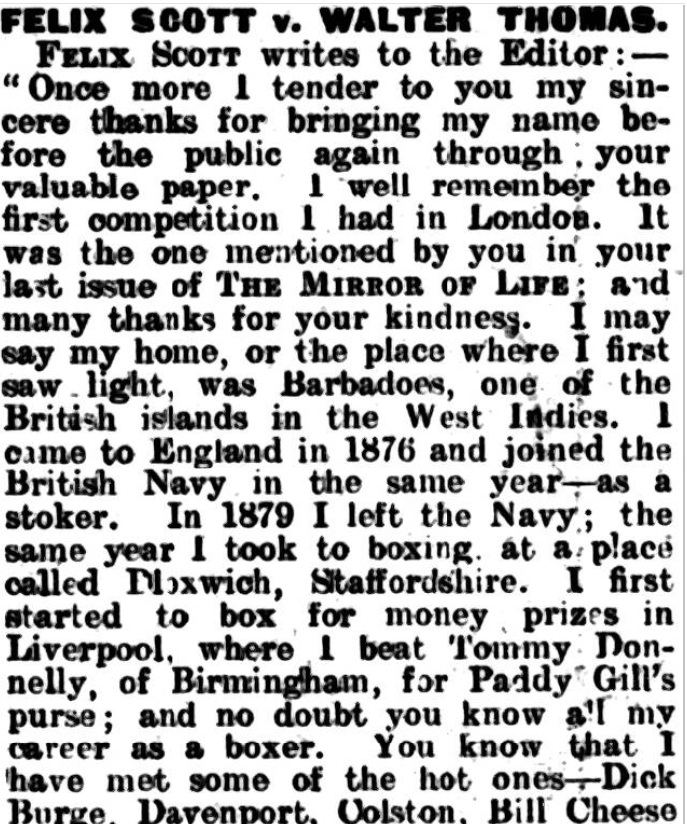
The Scotts moved on to Frome, where the locals continued to take up Scott’s challenges in his 14ft ring, and then on to countless other places, including Birmingham where we find them on the 1901 census, Scott’s occupation given as Professional Pugilist. In the middle of 1901, at the age of 45, he was still trying to get Robinson, or Cock Robin, to have a rematch, but with no luck. Instead he challenged Walter Thomas of Birmingham, signing articles to box the best of 15 two-minute rounds at catchweight. The Editor of the Midland Sporting News was to appoint the referee for the fight at the Birmingham and Warwickshire Horse Repository.
After weeks in training for both men, the match lasted all of 30 seconds. At the start of round one, Scott, the much larger man, was dropped to the floor by a hard right hook to the jaw. He was unable to rise, and was counted out.
The Scotts spent the Christmas of 1902 pitched up in Swadlincote, staying in rooms at the Engine Hotel, with Felix teaching lessons by day and offering boxing entertainment to Derbyshire miners by night.
In Bishop Aukland, a town in County Durham, in 1908, Scott took a man called Robert Hamilton to court because Hamilton had made threats to kill him. Scott – who was described as a widower with two young children – appears to have hired a female servant, who Hamilton had previously employed and had a sexual relationship with. Hamilton was apparently jealous of the woman’s relationship with Scott and made threats toward him. The case had, according to the Durham Chronicle, “a funny side, inasmuch as the prosecutor is a powerful coloured showman and the defendant is a man just over five feet in height”. Hamilton was bound over to keep the peace and pay costs. Whether or not Felix’s wife, Lucy Jane Scott, was still alive at this point or not is not clear. Family history research by a descendant on Ancestry suggests that she did not die until the mid 1930s. Scott may not, actually, have been a widower at this time, but the volatile couple appear to have separated. I have lost track of Lucy after the 1901 census.
In 1909 Felix Scott was sentenced to three months’ prison with hard labour for “ill-treating” his nine and 10 year-old daughters, Lillian and Nada. What he did to them, or failed to do, I have not been able to find out.
I understand that after serving his sentence, Scott was not reunited with the girls – on the 1911 Census we find them in a County Durham training home for female orphans, where dozens of young girls and teenagers were being prepared for domestic service.
Scott was travelling with his boxing booth in Scotland the same year and in July 1911 opened a boxing school on Corporation Street in St Helen’s, Lancashire. In Pendlebury, Greater Manchester, he hosted a boxing and wrestling tournament in 1914. He hosted a boxing tournament in Wigan in 1916, and was offering locals lessons in the art. He was still in Wigan in 1917, and still actively boxing at the age of 60.
Felix Augustus Scott was born in Barbados in 1856. He died on the 31st August 1920 in Wigan, England. He is buried in Lower Ince Cemetery, Ince-in-Makerfield, Wigan.
Nada Dorothy Scott continued to live in England. In her early 40s, she had a daughter called Rachel. Nada died in Manchester in 1975, and Rachel died in 2020. Lillian Scott moved to Brooklyn, New York, in 1924 and married a man called Andrew Clement. Lillian had lots of sons – Gerard, Victor, Francis, and Robert – and a daughter, Winifred. Lillian died in New York in 1978.
 Rediscovering the wrestlers and boxers of Late-Victorian London
Leave a comment