At the age of 45, Felix Scott was in the shape of his life. It was February 1902, and the Barbadian former Royal Navy stoker had been training hard for a match with Walter Thomas at the Horse Repository, Birmingham. Scott was pounding the roads out running every morning, punching the ball and wielding the dumbbells every afternoon. Upon the arrival of a Boxing World reporter, Scott displayed his muscles – “which stood out prominently all over his body” – for the writer’s edification. The writer declared him “hard as nails”.
Two years earlier, Scott had accidentally killed a man.
Please be aware that this article contains language quoted or screenshotted from Victorian newspapers which is considered offensive today. It also contains one description of male on female violence.
In 1900, Scott was touring with his boxing booth or pavilion. While based at a market place in Wiltshire, a 27-year-old named William Rose had taken Scott up on his challenge to locals for a “friendly bout with the gloves”. A minute into the second round, a punch from Scott knocked Rose to the floor, where he struck his head on the “hard roadway”. Rose did not rise. He was taken to a local hospital but failed to regain consciousness and died the following day. Scott, who had been arrested on the night of the incident, was remanded into custody.
Witness statements at Rose’s inquest from a Police Inspector Stevens indicate that the men were boxing in a “friendly spirit” and “laughing all the time they were in the ring”. The final blow from Scott struck Rose in the chest, and at the same time, Rose appears to have kicked or slipped on “something” with his foot which threw him off balance. Rose tripped, and fell, and smashed his head on the ground.
“Both men were quite sober,” Stevens added. Several other witnesses, including members of the police force, supported Stevens’ statements, and medical evidence indicated that Rose’s death was caused by hitting his head on the ground. He had no marks on him from any other violence (ie. from Scott’s punches).
This is something of a surprising turn of events given cases of a similar nature seen a couple of decades earlier, when policemen by and large fell over themselves to over-exaggerate ring violence.
It is even more surprising, given Scott was a Black man, and had once gained national notoriety for biting a chunk out of a policeman’s ear.
Felix Augustus Scott was born in Barbados in 1856. In 2017, research on Scott was undertaken by Jamie Calladine – then a History student at Liverpool John Moores and a volunteer with the Museum of Liverpool. His article shows that Scott joined the Royal Navy at the age of 20 and he travelled the world as a stoker, “shovelling coal into the ship’s great furnaces, a job which demanded an abundance of physical strength and endurance”.
Calladine has looked at Scott’s Navy record, and found him detained on numerous occasions overseas, including at Central Prison, Singapore and Victoria Gaol in Hong Kong during the late 1870s. For what, we don’t know, but the sentences appear to be short. We also know that he was then found guilty of something – exactly what, again I am not sure – court martialled, and imprisoned in England: because you can find him on the 1881 England and Wales Census in Winchester Prison. This appears to be the end of his time in the military. A little while later, Scott became a pugilist.
You might recognise his name from some of my previous blogs, including those on Hezekiah Moscow, Jack Davenport, and Albert Pearce. Scott was, for a time, based out of Liverpool rather than London like the Caribbean-born Moscow or Black American Pearce in the 1880s. He began to make a name for himself from around 1886, shortly after an incident where he got arrested for “hawking without a licence”.
There is a gap in Scott’s story between 1881 and 1886. I have found little trace of him beyond a disturbing short article – not mentioned in Calladine’s research – from the Birmingham Daily Mail in May 1882 when Felix Augustus Scott, “colliery fireman on tramp” was charged with attempting to strangle a woman called Kate Wathe. Scott plead guilty.
Kate told the Bench that she was living with Scott and they had been “tramping” from South Wales to Bedford where her parents lived. When they arrived at a lodging house, she told Scott that he should probably try and get some work so he could afford to buy new boots and continue his journey. He did not take kindly to the reminder of his unemployment, got angry, grabbed her by the throat and tried to strangle her. On addressing the court himself, Scott said that when he realised what he had done he apologised to Kate, begging her pardon and stating that “if she would not forgive him, he hoped Heaven would”. Scott then admitted to having strangled her on two prior occasions. He was sentenced to just one month with hard labour.
After this, I lose track of him for several years.
During the 1880s, England had no formal segregated title for Black fighters, as was the case in America. Championships were, as a whole, somewhat ‘unofficial’ anyway – The National Sporting Club (which later became the Boxing Board of Control) wasn’t founded in London until 1891. As I’ve mentioned before, there was technically no reason why we couldn’t have had a Black English champion during this time – there was no colour bar during the 1880s.
Despite this, several Black fighters at the time did vie for the claim to be the country’s ‘Black champion’ and several – particularly Moscow and Scott – are referred to by this title at different times over the decade. There does not seem to have been any particular interest in sticking to weight classes – Moscow typically fought at about nine and a half to 10 stone across his career, Scott was much taller – possibly about 5ft 10 – and seems to have been around 11 stone when he fought the much smaller Dick Burge in 1887, and down to about 10 stone on other occasions. Pearce, Jem Haines and Davenport were all heavier middleweights to heavyweights (11-13st).

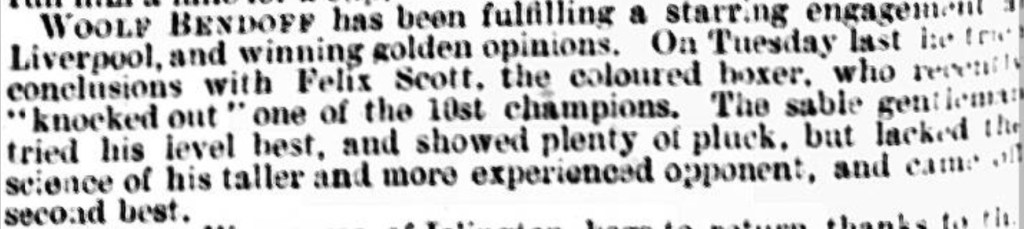
In the spring of 1887 Scott offered to fight any man around the 10st mark, and Tom Symonds, proprietor of the London boxers’ headquarters (the Blue Anchor on Church Street, Shoreditch) offered up the well known Ching Hook – or Hezekiah Moscow – and a £25 purse provided by a Paddy Gill. Symonds suggested the Liverpool Race Meet and “old or new style” – without gloves, or with, depending on Scott’s preference. The match does not appear to have come off at that time.

I just want to come back, here, to the comments made by some people who watched the first trailer for A Thousand Blows earlier this year. They saw a couple of Black boxers in Late-Victorian London, and called the show “over representative”. Yet this is the real life situation: across 1887, Felix Scott had numerous matches with other Black boxers, including Stewart from Glasgow and Smith from Birmingham. They sometimes ‘headlined’ a programme. In November that year, Scott was down in London and took part in a large programme of boxing at the Market House, a well-established boxing venue in Islington. One match featured a boxer called the Unknown Black, against a White guy. One featured Tom Tully, a Black boxer, against a White guy, and the final match of the night was Felix Scott against Stewart of Glasgow – who were both Black boxers. That’s four Black boxers on one programme.
A few weeks later, Sergeant Green, proprietor of the Red Lion off Fleet Street Lion, organised a catch-weight tournament specifically for Black boxers, with Hook (Moscow), Pearce, Scott, Stewart, and Albert Lyons all signing up, although Lyons couldn’t make it so Scott had his first match with Alf Ball – who was not Black (he was a Travelling Showman). Moscow and Scott reached the final. The much shorter and lighter Moscow held his own, and at one point took a blow much below the belt, only for the referees to ignore it. Much confusion seemed to occur around declaring the winner. Both the Sportsman and Sporting Life’s write-ups of the match put Moscow on top, and one judge agreed. The other didn’t and called for another two-minute round to be added, before the fight was ultimately declared a draw to the disappointment of all concerned. Both Moscow and Scott were regularly referred to as the country’s Black champion after this event.
In 1888 when a White guy called Tom Greenleaf failed to show up for his match in Canning Town against Bill Coulson, Felix Scott stood in (and won). Coulson’s second was another Black guy, Charles Bartlett (who was also known as Bartley or Meat Market Charlie).
So, yeah. Nothing about A Thousand Blows is “over-representative” – you just might think it if you don’t know the reality. If anything, it’s under-representative of East London in the 1880s. The show needs MORE Black boxers!
Anyway: Scott stayed in London over the Christmas period of 1887 and well into 1888, engaging in numerous events at the Lambeth Baths and other venues – by this point being regularly described as the Black champion of England. On the 20th December he had a notice placed in the Sporting Life addressing some of the recent challenges made to him by friends of Moscow’s, as well as Meat Market Charlie Bartlett, who had not entered Green’s competition. The notice said that Scott was far too busy, but he could probably make time for a match if someone put up a £100 prize.
Scott continued to box prolifically at events in London into 1888, including hosting his own tournament, regular sparring with Stewart, and – again, with Stewart – engaging in a new twist on the classic (and ‘of its time’…) Miller and the Sweep boxing burlesque at the Royal Albert Music Hall in Canning Town. Whereas traditionally a Black boxer would rub coal on his gloves and a White boxer would rub flour on his before a fight: both Scott and Stewart whitened their gloves, and then fought each other.
Soon after, Scott and Stewart were put in charge of organising Saturday and Monday night boxing at the Mile End Gate Tavern, Whitechapel. When I talk about Black boxers in London at this time being ‘equal’ in the boxing fraternity – even if they might not have been viewed as such by much of society, and even if the language used by the sporting newspapers sometimes isn’t ideal – this is the sort of thing I mean. Scott, Stewart, Moscow and others were all well known and well respected instructors, gym managers and MCs in multi-cultural, but still overwhelmingly majority-White, London during the 1880s. They gained respect, reputation and a prominent place in their community because of their talent and hard work in the ring.
A benefit held for Scott in early 1888 was, sadly, poorly attended, but a write-up in the Sporting Life, which describes Scott as “meritorious” and “well behaved” is particularly ironic to read now when you consider the fact he had (allegedly) bitten a chunk out of a policeman and was technically, at that time, on the run from the Liverpool law.
At the start of June 1888, a competition with a prize of £25 was open to men of all weights at the Pelican Club in London. Scott was declared the winner of his match with Jack Davenport – another Black boxer, and the much heavier man. He won on a foul after being struck very low but was unable to take his spot in the final, which saw Alf Mitchell beat Alf Ball for the win. No serious harm was done, and Scott was promptly back boxing exhibition matches, planning a rematch with Davenport, and challenging Albert Pearce.
On the 6th June he was sparring in a pub off Fleet Street and he was definitely in London during the third week of June, where he could be found boxing again. On the 27th June he had his rematch with Davenport at the Pelican Club – a ten round contest for a large cash purse, which was won by Scott. He was on something of a roll.

But according to the newspapers, on the 12th of June 1888 – I’ll explain all this stuff about the dates and cities and where he was in a minute – he had apparently been up in Liverpool and was supposedly involved in a fight with some other men at 2am, causing a disturbance in a court off Harrington Street.
A Policeman, Frederick Beattie, ordered the men to disperse and Scott then, according to Beattie’s statement, used bad language and struck him twice. Beattie drew his baton and Scott ran off into a house. Beattie chased after him, entered the property, and the two struggled and fell to the ground. That’s where Scott apparently “got the constable’s ear in his teeth and gnawed it off”. He then made his escape out the front door and disappeared into the night, and out of Liverpool for the foreseeable future.
Scott was arrested on the 11 July 1888, moments after winning the final round of a tournament for 10 stone men, beating Harry Williams of Southport in the fourth round. The evening show was patronised by the great and good of the London, Midland and Northern boxing circles at the time, including the champions Jem Smith, Charley Mitchell and Jake Kilrain.
Neither the Sporting Chronicle or Sporting Life’s coverage of this event mentions that as soon as Scott was declared the winner, a policeman entered the ring and arrested him for his activities on the 12 June. The London Evening Standard and others did, over-exaggerating Scott’s physique and reputation – he was repeatedly described as “a powerful Negro” to conjure images of a hulking brute (yes, he was a tall man for the period, and fit, but at 5ft 10 and 10st or 140lb I would hardly describe him as a ‘big’ man, and at 10 stone he was a lightweight boxer). The competition he had just won was described as “the 10 stone championship belt of England and Scotland”. He was variously referred to in headlines as a “cannibal” implying he ate the ear, or it was suggested that he might have bitten off the whole thing. It sounds like it was just a chunk? I mean, that is horrendous, but not QUITE as horrendous as the press made out.
I can not find any press coverage of the original incident. It may or may not have been reported at the time. When Scott was arrested in July 1888, most newspapers refer to the assault having occurred the previous month. A report from the trial published in the Huddersfield Daily Examiner and some other sources, say it was actually the previous year, which makes more sense, given Scott’s lengthy residency in London from 1887-1888. He’d stayed in London for the best part of the year because he was wanted in Liverpool. Others said it was 12 June, others 20 June. Facts are facts unless they’re reported in the Victorian press.
At the Liverpool Assizes, Scott was found guilty of unlawful wounding and sentenced to 18 months with hard labour. Most of the newspaper coverage did, this time, clarify that it was only a bit of the ear, and he had been “at large” for 12 months. While Scott admitted assaulting the constable, he maintained that he had never bitten the man’s ear, and the severe injury were due to a cut during their scuffle on the floor. Scott also said that the constable had used his baton freely upon him.
Ann Masters, the wife of a mariner, who lived in the house in which Felix Scott had entered and allegedly bitten an ear off, stood up in court and said that she believed the officer, Beattie – not Scott – appeared to be under the influence of drink. She also saw blood on his ear soon after he fell to the ground with Scott. The jury still found Scott guilty. I find the discrepancy between his sentence (one month) for the repeated strangulation of a girlfriend in 1882 and the sentence (a year and a half) for assaulting a policeman quite interesting. Some things never change, do they.
It is remarkable, and remarkably frustrating, that we don’t seem to have any photographs of Felix Scott. I am pretty certain at least one existed, likely in the same style as Hezekiah Moscow’s now very well known 1888 studio portrait. There are photographs of unidentified young Black Victorian men held in archives in London, in smart suits that don’t betray an occupation. There are photographs of Black boxers in touring fairgrounds in the early 1900s, names unknown. He’s got to be among them.
Thanks to the work of a descendant on Ancestry, I have seen photographs of one of Scott’s daughters (we will meet his White Welsh wife in Part II) and one of his grandsons. I really hope Felix will come to us one day.
 Rediscovering the wrestlers and boxers of Late-Victorian London
Leave a comment