There are mysteries in my research that I’ve never managed to solve, however many hours I’ve spent trying. There are questions I’d like to answer, but I’m not sure I ever will.
Why did Hezekiah Moscow leave for New York? What happened to him there? When did he die? And was his ‘real’ name ever really Hezekiah Moscow? Who were Violet and Rosaline Mills? Were they actually Mexican? What happened to James Haines’ wife and child? Do his descendants live on in England? Will I ever get an agent and a book deal and actually make something of any of this? Questions, questions.
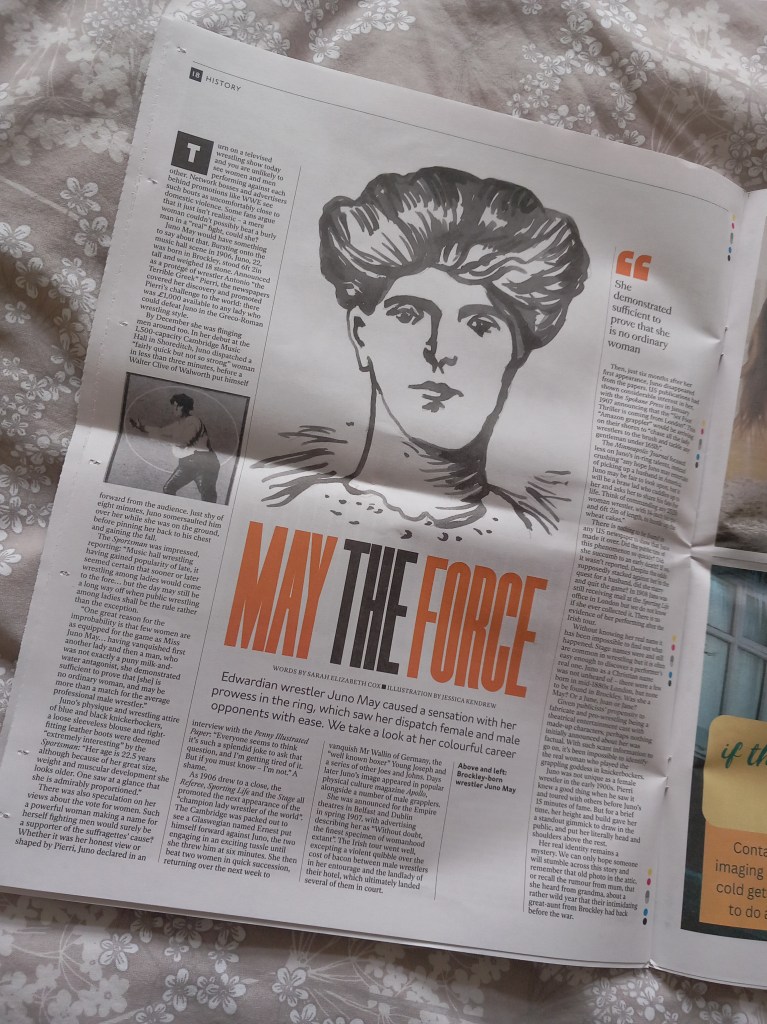
In March 2021 I published two blogs on a female wrestler named Miss Juno May, and then wrote an article about her for my then local newspaper, the Lewisham Ledger. Her story was a little detour from my usual focus on the 1880s and 1890s, but when I heard about a 6ft 2, 252lb lady grappler flinging men around music halls in the early 20th century, there was little chance I could let her lie.
- “252 Pound English Girl Seeks Fame on the Mat!” Introducing the Graeco-Roman Goddess, Miss Juno May (Part I)
- “Six Foot Thriller is Coming from London!” Introducing the Graeco-Roman Goddess, Miss Juno May (Part II)
To briefly recap, the discovery and forthcoming debut of Miss May was announced via a press release from her manager, Antonio Pierri, in October 1906. The newspapers went crazy for her. And then, after a couple of London performances, a short trip to Dublin, and a suggestion that she may be travelling to America but no evidence that she actually did, she had disappeared by May 1907. Her name occasionally popped up in sporting magazines at later dates, but there was no sign of her being active as a performer.
I have not managed to find out what happened to her. The main reason for this is that I have never managed to discover her birth name.
The following fact will come as no surprise to historians of wrestling but it might to a more general reader: wrestling has been a work for much longer than you think it has been a work.
When people, and by people I mean men, of a certain age react to my research with something along the lines of “do you watch that WWF? That fake shit? It wasn’t like that in my day…” I struggle to respond with more than a hefty sigh. Unless you are 200 years old and were watching wrestling in a Cumbrian field in 1840 (and even then…): that wrestling you watched is a work. As a researcher looking at the late-Victorian and early Edwardian parts of its history, with the resources available to me, it’s a difficult – albeit often quite fun – job to get to the ‘truth’.
A bit, some, very little, or nothing at all about Miss Juno May that was announced by Mr Pierri in his 1906 press release was likely to have been true. She wasn’t the lady wrestling champion of the world (she hadn’t even wrestled yet!). It wasn’t her real name: I’d have found her through birth, census, and death records by now. She might have been born in Brockley, or somewhere else entirely. 18 stone could be right, or they’ve bulked up a little extra on the curvy girl to impress. 6ft 2, perhaps, or Pierri’s added a bit and there’s another bit more in a chunky-heeled boot. She could have been 22 years old, or she could have been 25, or 32, or 40. There was no high definition photography in those days.
Professional wrestling is a performance, created by actors playing characters, and thus it has long, long been. And Antonio Pierri was a master craftsman.
Earlier this year I was contacted by a Los Angeles-based film producer and director and self-declared amateur pro-wrestling historian named Joaquin Poblete who, it turns out knows a hell of a lot more than me about almost everything – and has apparently read every word I’ve written. A breathe of fresh air! Through lengthy emails we discussed my contribution toward an exciting project he has been developing for some time, and in August we met in London to work on it.
While setting something up around a corner in a historically important and very beautiful wrestling venue, and in the midst of talking about something else entirely, Joaquin shouted out at me:
“By the way, I think I know who Juno May is.”
Excuse me?
A few weeks later, he kindly sent me some research he’d been compiling which included a most exciting clue. It’s a clue that – I’ll tell you this now – didn’t solve the mystery entirely but did take us a big step closer to pinning her down.
Joaquin, you see, had been researching Juno’s manager and publicist Antonio ‘The Terrible Greek’ Pierri: something which I, in all the very many hours I’d spent trying to piece together Juno and her life, had somehow pretty much entirely neglected to do.
Why hadn’t I? Well, Pierri was, and is, quite well known to wrestling historians of the late Victorian and Edwardian era. He’s the original Terrible Greek. A huge figure in the development of pro-wrestling. I supposed that other people had already researched and written about him and there wasn’t much left for me to do. And I knew that Juno May was just one of many people Pierri represented during the early 1900s, so focusing on him rather than her wasn’t going to be much use in working out her real name.

In 1906, Pierri did his press release, he hooked her up with a few gigs as her manager, and then it seems – because she disappeared so quickly, less than six months after debuting – he dropped her and moved on to other clients. Lady wrestlers before and after weren’t scarce. She was the tallest and biggest of the bunch, by far. But perhaps something else came up. For him, or for her.
Antonio Pierri had a tumultuous 1907. The timeline, as best I can follow it through digitised British newspapers is as follows:
In January 1907 he put up an impressive amount of cash for anyone who can beat Juno at the Cambridge Music Hall in East London. £5 for any men who can go 15 minutes with her or £100 for any ladies who defeat her. Sorry to break it to you, but it’s likely anyone she went up against was a plant…
On the 5th of March he was, according to several newspapers, dangerously ill with pneumonia at his South London residence, his condition so grave “doctors will not allow even the patient’s most intimate business friends to see him”.
A Sporting Life reporter knocked on his door on the 8th March and was allowed to see him. He was much better, “and wished to be remembered by all his friends”.
By May he was acting as Juno’s manager in Dublin.
In early August he was on tour in England, introducing his new troop of female and male wrestlers and weight lifters with dwarfism.
In mid-late August he “returned to London from the wilds of Macedonia, where he succeeded in finding two Turkish wrestlers whom he is confident are the best the world has yet produced”.
So between nearly dying, touring with talented dwarves, and poaching Turkey’s finest potential challengers to Hackenschmidt, the heavyweight world champion, is it any wonder Miss May’s career hit the mat in 1907 when the bell had barely rung?
Here’s where Joaquin’s findings come into play. Firstly, Joaquin sent me over a PDF with a few clippings from newspapers, ship passenger lists and obituaries published upon Pierri’s death in 1912. Two particular pieces stood out.
The Sportsman in August 1912, shortly after Pierri’s passing, published a short article on his life and career which mentioned, briefly, his wife: “a clever, accomplished, amiable lady”. We learn, too, that Pierri died from a combination of rheumatism and asthma at his beautiful home in Strasbourg. He left a widow but no children. He was 5ft 9 and a half.
A second clipping dramatically raised both eyebrows to my hairline. This was published in 1905 in the Waterbury Democrat, an American newspaper from the state of Connecticut, on the occasion of Pierri arriving in the US on the ship Kronprinz Willhelm. The date is over a year before Miss Juno May is announced to the English press as a champion wrestler and his protege.
They [the lady wrestlers] are chaperoned by Mrs Antonio Pierrie [sic], wife of the wrestler known as “Terrible Greek”. Mrs Pierrie took her strenuous charges to a boarding house in Brooklyn soon after they landed. The chaperone is a tall, good looking English woman, with an accent eloquent of Bow Bells.”
Tall, you say?
As an almost 5ft 11 woman myself, partial to a cowboy boot or Cuban heel which nudges me over 6ft, I can attest to the fact that being lengthy is something that people comment on. Not in a gawping, good grief she should be in a freak show, sort of way. My 6ft 1-in-her-stockings sister might have something else to say on that. But it’s noticed. It’s observed in exactly the sort of way this newspaper journalist observed it. Particularly when your partner is 5ft 9. Oh you’re very tall aren’t you. It must be lovely being so tall! Is your mother tall? Sorry, love, you wouldn’t mind getting this off the top shelf for me, would you?
Would the reporter have made a point of noting her height if she’d been, let’s say, an above-average but not absurdly so, 5ft 7? That’s quite tall, very tall for 1905, but not TALL tall. If she’d been a little shorter or similar in height to Antonio, would they have said anything? Might they have mentioned her hair colour, or the shape of her hands (as olde newspapers were prone to doing) instead?
But it was “tall”. She was “a tall, good looking, English woman”. How many so-tall-it-must-be-commented-on women were around at the time, and how many did Antonio Pierri surround himself with between 1905 and 1907?
And let’s say this Mrs Pierri was actually from around Brockley, for example, in South East London rather than closer to the Bow Bells in the East End (making her a “cockney”). We can certainly understand that an American reporter might have got a south and an east London accent confused. It would have been neither here nor there. I lived in both parts for many years, and couldn’t tell you.
So what we’re saying here – what Joaquin is saying, and what he told me, and what I’ve become absolutely convinced might be the case based on fairly scant evidence – is that Miss Juno May was actually Mrs Pierri.
As Joaquin and pro-wrestling historian Patrick Reed (buy his book) have both suggested, it’s easy to imagine they may have been some sort of husband-wife wrestler-promoter duo. Mrs Pierri is described as “accomplished” in a newspaper obituary for her husband – did she perform in the music hall as something other than a wrestler, or manage lady wrestlers or other performers herself, independently or alongside Pierri, perhaps?
Where this theory only got us so far, at first, is that we didn’t REALLY know who Antonio Pierri was. The man created characters. He created Miss Juno May, he created himself, The Terrible Greek, and he created many others.
Digging beneath and beyond and figuring out who he actually was, was harder. On Cagematch his birthplace is given as Syros, Griechenland – a Greek island – but they also have his death year as 1920, when we know it to have been 1912.
On Friday 16 August 1912, the Sporting Life reported that Pierri was dangerously ill at his Strasbourg home, and that Hackenschmidt had taken great interest in his welfare and paid him a visit. A couple of days later his death was announced, the British regional and sporting newspapers offering a variety of levels of detail about his life. But as obituaries of wrestlers then generally did, they focus almost entirely on his career – one brief reference to an “accomplished” wife, aside. He was supposedly 58. Or 53, it depends on what you read. His real nationality? His real name?
‘Antonio Pierri’. It doesn’t sound very Greek, does it.
Joaquin’s next emails brought major breakthroughs.
Through a contact named Christian Gaildraud, he had managed to obtain a copy of Pierri’s much-sought-after death certificate from an archive in Strasbourg. In printed German, filled in with swirly German handwriting, it gives Pierri’s real name, his age (53), place of birth – Syros, Greece – and the name of his wife.
It may already, perhaps, be ‘out there’ in the depths of pro-wrestling forums, but I won’t be telling you Pierri’s real name here. Why? I’m not sure. It might sound silly, but I feel uncomfortable about exposing the great kayfaber’s identity. It might also be because this was not my discovery. It doesn’t feel like my information to publish.
I will tell you though, because this is what I am writing about, really, that the death certificate does give his widow’s name: Johanna Maechling.
Address books for Strasbourg in the years 1911-1914, also sent to me by Joaquin, show her continuing to live on at the couple’s address, where she is described as a “retiree”.
There are a few things to consider here.
Firstly, the wife he had in 1912 might have been a different wife to the wife who was described as “tall” by a newspaper in 1905. We don’t know.
Johanna Maechling appears to be the correct spelling of his wife’s name on Pierri’s death certificate but I cannot find any traces of anyone ever existing by this name in the archives currently available to me (nor under Joanna, or some similar versions of the surname), or a Johanna Pierri or Johanna followed by Pierri’s real Greek surname.
While the spelling of her first and surnames does not immediately say “English woman from Brockley” to me, we do not of course know that she was definitely English or definitely from Brockley at all: these were part of a story created by Pierri for Juno May’s press release in 1906. And an interesting point to note is that in October 1906, Juno May gave an interview with the Penny Illustrated News about her starting a wrestling career and mentioned that her father was in South Africa. She does not say whether he is South African himself, or whether he is there perhaps with the British military. Names of Germanic origin are, of course, very common in this part of the world. She may have been British, or had a British accent, but be of South African or European heritage.
And then, of course, there’s this:
Johanna Maechling… Johanna Mae… Juno May.
Come ON now.
So that’s where we are, currently.
“Pierri had an astounding faculty for making the public believe what he said and caused to be written,” wrote a Sporting Life correspondent in their obituary for “one of the greatest personalities”, the man “who created the professional wrestling boom”, “the hippodromer”, who “achieved many triumphs”. The fellow “did more harm to genuine wrestling in this country than any man who ever lived”. I can tell The Cross-Buttocker wrote that last one without even checking. Did Antonio Pierri turn his big, tall, handsome British wife into Juno May, the wrestler, then he, or they, had second thoughts about it all and they turned their attention to more profitable ventures?
I still can’t tell you who Miss Juno May really, definitely, was. Yet. But this feels like a very good start.
Joaquin’s been looking at ship passenger records. I’m trying to find out how long Pierri occupied his London residence in Lambeth – south London, yep, close (ish) to Brockley, where Miss May was supposedly born – and who he might have shared it with, before, during, and after, he almost died there from pneumonia in 1907. We’re continuing to try and find out more about Johanna Maechling, with the Googling-ability, Strasbourg contacts, and incredible AI translation services currently on hand.
It’s only been three and a half years since I began to grapple with Miss May’s story and identity, and I’m not tapping out just yet.
As always, we welcome tips and hints if you’re confident that you’ve got something that will help: grapplingwithhistory@gmail.com
 Rediscovering the wrestlers and boxers of Late-Victorian London
Leave a comment