William Caddell Lewis was a tougher man to research than I anticipated.
We can find out this much from information published in newspapers during his lifetime, or shortly after his demise:
He went by Punch Lewis, W.C. Lewis, and is occasionally referred to as Bill Lewis, but his full name was William Caddell (Caddell being a Welsh name, meaning ‘battle’) Lewis.
Caddell was a second Christian name rather than part of a double-barrelled surname. He had a wife called Annie, three children, and he died in November 1883, less than two years after opening a boxing saloon at the Blue Coat Boy, 32 Dorset Street, opposite Spitalfields Church in London’s East End.
Lewis was buried in Manor Park Cemetery, Ilford, Newham, on 2 December 1883 and at the time of his death he was 39, apparently dirt poor, and Annie was left destitute. He had once been a boxer, stood 5ft 7 and a half, and his lowest fighting weight was 9st 2lb.
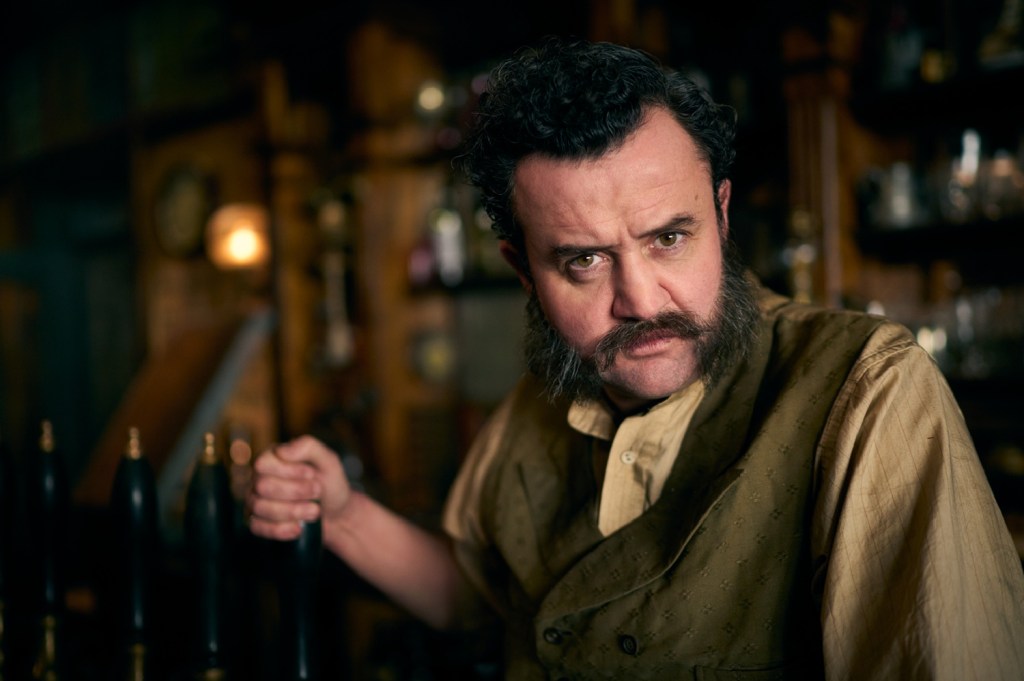
© 2023 Disney and its related entities.
A list of residents at the Blue Coat Boy pub from 1808 to 1915 is available online and it includes Lewis for 1882, alongside a Nathaniel White for 1882 and 1884, and has his full name as William Caddell Lewis.
I thought that the unusual middle name of Caddell should make him easy to find among birth and marriage records, the 1881 census and so on, yet an Ancestry search drew only his death certificate, which matches the date reported in the newspapers and his approximate reported age and location: William Caddell Lewis, estimated birth year 1844, the death in 1883 registered in Mile End, London.
I couldn’t find him as William Caddell Lewis, or slight variations of, on any censuses. Using the above information, I’d believed him to perhaps be the William Lewis born around 1844 in the British territory of Malta, who was married to an Annie and lived in Camberwell, London, before dying in his 40s. Further digging showed this fellow’s middle name to be John, however, and he outlived ‘Punch’ by four years.
Since Punch had opened a boxing saloon in a rough part of East London in 1882, I’d assumed him to have been an East End institution, living and working and punching in the district for many a year or decade, although it was odd that I couldn’t find much detail on his earlier boxing career, in which he was likely known as Bill or Punch, in London’s sporting press. I still haven’t, but continue to look.
Here’s part of the reason why: A list of licensees for public houses in Norwich (which is nowhere near London at all, international readers) has a William Caddell Lewis at the Spread Eagle for August 1880, with a William Burrage holding the license by May 1881. Searching for a William Lewis (no Caddell), with a wife called Annie, in Norwich in 1881 brings up our man at the Spread Eagle: a 36-year-old publican, born in Norwich, living at his premises with Annie, 30, and their children: six-year-old Frank, five-month-old Harry, and a three-year-old daughter who looks to me to be called Maud but it has been transcribed by Ancestry as Maria.
Why and when, then, did Punch move to London and open a boxing saloon in a pub on the worst street in the city? I’m still trying to figure that out.
He was born in Norwich, according to the 1881 census, but his two oldest children, Frank and Maud/Maria were born in Chelsea, west London.
I haven’t found a marriage registration for Punch and Annie yet. I can’t find him, with or without Annie (she would only have been 19 or 20, and perhaps they weren’t yet married) on the 1871 census in Norwich, or in London. Maybe at that point he, or both of them, may have lived in London, and they had then moved to Norwich and then back again.
In the course of digging for information on Punch, some interesting documentation emerged for his eldest son Frank, whose full name was Frank James Cadell (with one ‘d’) Lewis. In 1922, Frank applied for Freeman status in the City of London, Freedom papers being a historic status for London businessmen meaning: “a man who did not have to pay trade taxes and shared in the profits of his borough, a person free of feudal service who had served their apprenticeship and could trade in their own right, and anyone who was a member of a City Guild.”
The Freedom papers name him as the son of William Lewis, late of Dorset Street, even though Punch had been dead almost 40 years. Frank died in 1937 in his early 60s, leaving £670 to his widow, Elizabeth Sarah Ann Lewis. Like many a Londoner, he’d moved east to Ilford, Essex, by then.
But back to Punch.
The birth of a William James Cadell (one ‘d’!) Lewis was registered in the first quarter of 1846 in Norwich, England which could be the same William Caddell Lewis who is Punch Lewis, given how unusual the middle name Caddell, or Cadell is.
If you’re wondering at this point how much of my research is thwarted or delayed by terrible old handwriting, bad transcriptions by genealogy databases, lots of people being very illiterate back in the day, search issues involving quote marks and apostrophes, and a variety of other admin factors, including the inability to access a lot of expensive subscription services right now, the answer is: a lot.
Why does any of this matter?
In the forthcoming TV show A Thousand Blows, there is a character based on Punch Lewis present at the Blue Coat Boy, and I was overjoyed to find one of my favourite British actors, Daniel Mays, to have been cast. It’s a small but memorable – in the way in which Daniel Mays is always memorable – role.
I want to find out more about the real man, particularly as he (the real Punch) seems to have played a leading role in starting Hezekiah Moscow, known usually as Ching Hook in the boxing ring, on his decade-long pugilistic career.
As always, note that A Thousand Blows is inspired by real people in a real place but is very much a work of fiction – you won’t get any plot spoilers from my blogs on Sugar Goodson, Hezekiah Moscow, Alec Munroe or Punch Lewis.
Sadly, the two black bulldogs the real Punch kept chained to the bar were considered a detail too far for filming budget and logistics for A Thousand Blows’ producers, despite my urging.
At the time of his death, Punch Lewis was living – according to the Sporting Life – at 37 Raven Row, Sydney Street in Mile End. I cannot find any sign of this address still existing today, but so much of the area is now unrecognisable that this comes as no surprise. There was a Sidney Street, and it became very well known in 1911.
The Sporting Life reported his death on 28th November 1883 and attributed it to heart disease and dropsy, giving his age as 37. They noted that “he was at one time the host of the Bluecoat Boy, Spitalfields, but reverses caused his retirement from business”.
In brief coverage of the funeral on 2nd December, Annie was described as destitute in the newspaper. A group of East End boxers, Tommy Orange and Dave Cable among them, quickly organised a benefit in Punch’s memory at the Griffin pub and boxing saloon on the High Street, Shoreditch, to help her out financially and to pay for his funeral. The attendance at the funeral was described as “immense” and consisting mostly of “sporting men” keen to pay their respects.
On 5th December 1883 the Sporting Life published brief details on Punch’s life, but the British Newspaper Archive’s copy is too worn for me to make out some of the wording. It appears to say something along the lines of “A long and p—- [painful?] —— having completely exhausted the means of poor Lewis”, suggesting that a long illness prevented him working.
Two weeks after his death, the Blue Coat Boy’s boxing saloon was taken over by Robert, or Bob, Dunbar – a one-eyed boxer, previously based in Bristol, and reopened.
Five months after Punch’s death, Annie was advertising in the Sporting Life that her “booth” would be travelling to Epsom races – you’d find her located in the Avenue at the back of Barnard’s Stand. Ales, wines and spirits of the finest quality, cigars of the best brand, and management by Simon Finighty and William Maclean.
Since Finighty was a well known featherweight boxer but also – according to his obituary in 1890 – an assistant for race meet catering firm Keene and Brown, I’m not quite sure if Annie’s Booth was a travelling boxing booth, a travelling bar, or both. Either way, it sounds as if the East London boxing fraternity helped her get back on her feet after Punch’s death.
Just as I was finishing up this article I came across an article on boxing houses which sheds some light on why the Lewises were in such difficult circumstances at the time of Punch’s death. It makes sense to finish here with it. Printed in the Sporting Life on 21 December, 1883, just a few weeks after Lewis’s demise, a columnist known as Cestus explains:
“I must say that it afforded me the greatest pleasure to see an establishment boasting possession of a room thoroughly well adapted and appointed for the purpose of boxing displays – which had been closed for the greater part of a year – open again under most favourable auspices.
I allude to the Bluecoat Boy, Dorset Street, Spitalfields, which owed both its formation and its existence as a boxing house to a former landlord and well known boxer, “Punch” Lewis.
Poor “Punch”, who, by the way, paid the last debt to Nature and was carried to his grave within the present month, was not a success as a landlord, and although at one time in his short-lived career as Boniface it just looked probable that he might develop into prosperous “bung”, there were too many temptations abroad for “Punch” to withstand [eh?]. So by neglecting a business which needed all attention to be paid profitable, he gradually dropped out of it, and towards the end both he and his young family were in absolute want.
Turning from this unnecessary recital to what concerns the house, “Punch” Lewis in the first few weeks of his proprietorial career worked like a Trojan, and spent a lot of money in the arrangement of a boxing saloon, which it was his pleasure to think would be beyond all doubt the best in London. Although, when the room was finished and ready for exhibitions it did not realise either the expectations of “Punch” or his friends, it without being the absolute best in London was a fine and lofty and spacious room, a long way above the average East End saloon.
The saloon which was, and of course, is, detached from the Bluecoat Boy proper, was (and is) large enough to accommodate between two and three hundred people, a strong gallery being erected at the entrance end for those willing to pay for extra accommodation.
Situated right in the centre of a district where everybody can box a little, [I love this description of East London!] it was only natural to expect that, with a good room at his disposal, a well-known boxer like Bill Lewis, would be sure to score successfully and make the Bluecoat Boy fairly tipple again.
I was myself of this opinion, and for a few weeks the newly-opened business went along with what our trans-Atlantic brethren call a “hum”, and then the “boom” became less pronounced, and in a few months boxing entertainments at the Bluecoat Boy may be fairly said to have discontinued.“
The writer continues by saying that while he does not mean to disrespect the recently departed Lewis, he does have a theory about why the business did not do well and what other boxers who may be tempted to start their own houses might want to consider in order to avoid a similar fate.
It is difficult to make out what he is alluding to – I thought he may have been suggesting that Lewis’s saloon was known for advertising boxing in “the old style” (ie. barefist) but only providing audience members with gloved sparring, but I can’t see any sign of this in the venue’s newspaper promotions. Or is he saying people were coming in to watch boxing and then there wasn’t any boxing at all? I’m not sure what to make of it.
“The reason, in my opinion, why the boxing saloon at the Bluecoat Boy was not largely patronised by the public was not that the arrangements as to their comfort were inadequate, not that the entertainments, when they took place, were bad or even of a middle-class description, but simply and solely because those who managed the affairs scarcely ever kept faith with the public, who consequently got sick of being eternally trapped in paying in order to witness an advertised something which never by any possibility came off.”
Cestus concludes that Bob Dunbar, a boxer of the most civil, well-qualified and obliging character, has a very good chance of making the Blue Coat Boy more of a success, should he decide to work hard at it. Poor Punch: a painful and lingering death from heart disease and dropsy, and he’s criticised for being lazy by his peers in the aftermath.
Punch Lewis died in 1883. His son Frank James Cadell Lewis was born in 1875 and died in 1937. I am yet to research the other children, but I do hope that through this I can trace a descendant or two, or they may come forward proactively as many others (including some of the great great grandsons and daughters of Jack Wannop, Alf Ball and Sugar Goodson) have done.
If you’ve found this by Googling your ancestors, please do get in touch. It’s quite the honour to have Daniel Mays bring him back to life.
 Rediscovering the wrestlers and boxers of Late-Victorian London
Leave a comment