In a blaze of publicity, Peter Jackson, Black heavyweight champion of the world, arrived in England at the end of August 1889.
In order to satiate public demand to see him, line some pockets, and escalate interest in his forthcoming match with the English champion, Jem Smith, he spent the second week of October installed at Astley’s Amphitheatre in Westminster, taking on challengers. According to the Sporting Life, “the hero of the hour” struggled at first to find anyone up for a fight, such was his reputation and “immense stature” – a smidge over the rare 6ft.

Wannop, Jem Haines or Jack Davenport’s 5ft 8.5 or 9 and 13 stone in weight were considered sizable among the rather petite and generally malnourished boxers in London at the time: there were few heavyweights to be found in this place and era and fewer still with the reputation, or balls, to get a crack at Jackson.
And, of course, this was a week-long residency designed purely to get Jackson on show and warmed up for the main event.
In stepped Jem Young, a Mile End middleweight significantly outclassed in size, for a three round spar. “The immense hall was crowded in every part,” noted the Sporting Life, and when the “genial” American promotor Parson Davies announced the boxers he was greeted with encouraging applause. Young “acquitted himself with credit” over three rounds with Jackson “of the most friendly nature”.
Davies announced the rest of the week’s competitors battling for £10 if they could last four rounds with Jackson: Black-American-based-in-London Jack Watson on Friday (almost as tall as Jackson and possessing “a pair of arms of pitchfork longitude”), Coddy Meddings on Saturday, and Alf Ball – now recovered from his broken arm – on Tuesday.
Jackson drew in a crowd all week, but his night with Alf Ball attracted the largest of the lot. According to the Sporting Life, the reason for that “was not all that far to see when we mention that Alf Ball of Deptford was billed to box”. The newspaper continued:
“That a genuine trial of skill goes down with the public was very evident last night, and so great was the crush that every reserved seat was taken fully an hour before the rivals were due. The promenade too was crowded, whilst every coign of ‘vantage about the building found a customer.”
Davies introduced Ball and Jackson at 9.30pm and informed spectators that a Mr Joseph Thompson would act as timekeeper. Jem Mace – ever present, it seems, in any boxing story one can tell from almost any decade – was to be referee.
The men shook hands, then Jackson, after feinting, drove his left into Ball’s torso. He boxed Ball into the corners, knocking his man straight into some chairs. Ball rose, and delivered a smart left to Jackson’s cheek, before Jackson had him back down to the ground. Ball was back on his feet before the ten-count. Rushed by Jackson, he stayed at close-quarters, trying to avoid damage. Seconds become time was called, he took heavy blows from both Jackson’s fists and was back down on the floor.
Slumped in his corner chair, Ball’s face was showing signs of significant punishment and his breathing was heavy. Upon rising for round two he was caught hard in the ribs by Jackson but then caught the Australian off guard, landing a heavy left and right to Jackson’s face. Ball fought on in plucky style, avoiding major blows by staying close for a couple of minutes.
After a stinging left hander and a heavy right from Jackson, Ball was once again horizontal and this time failed to rise by the count of ten.
Following a handshake between the men, Parson Davies declared Jackson the winner, and noted that while Alf Ball could not lay claim to his prize tenner, “bearing in mind his brave fight, he will not go unrewarded”.
On 23 October a message appeared in the Sporting Life titled “Alf Ball on the war path”. It read:
“Alf Ball, failing to get a match on with either Toff Wall or Bill Goode for the middle-weight championship, is now open to box any middle-weight in England, Alf Mitchell for choice, not being pleased with the last encounter with the last named.”
Pining for a chance to get his own back after their previous knuckle fight ended in a loss and a broken arm bone, this time Ball wanted strict Queensberry Rules – ten or twelve rounds with medium sized gloves, for £100 or £200 a side, and a suggested date of six weeks’ time.
It was an immediate yes from Mitchell. The old opponents met at The Sportsman’s offices and agreed to twelve rounds wearing medium gloves on 16 December, with prizes of £100 to the winner and £50 to the loser to be provided by Charley Smith of the Oxford and Cambridge Club, J. Baldock and Tom Symonds of the Blue Anchor.
Mitchell and Ball – having both faced Peter Jackson at the start of the month and impressed the crowd – were then also both matched with another heavyweight champion from Down Under in Frank Slavin at the end of October. The pair were booked to kick off a series of exhibition matches for Slavin at the Royal Aquarium ahead of The Australian Wonder’s planned meeting with Jem Smith in the old style early the next year – which ultimately took place in a field outside Bruges.
Slavin pulled in the crowds at the Aquarium, with the Sporting Life reporting that “lovers of the noble art were there in full force” on opening night. Jem Mace, of course, was observed to be present.
Mitchell was up against Slavin first, with both men introduced to good reception by promoter Frank Hindes. Three rounds of “excellent sparring” followed, Slavin taking the upper hand with his upper cuts. The men retired to loud applause. Ball was the challenger on night two, and to “hearty applause” sparred three rounds – although with such disparity in size that neither showed to best advantage, according to the Sporting Life. While Slavin’s superior reach kept Ball at bay, the much smaller man “proved himself wonderfully agile and tricky”.
“It was asking too much for him to hold himself against a giant of the Australian’s calibre,” concluded the Life.
“Occasionally the little ‘un managed to get home, and on the whole the company were very well pleased with the display.”
At the start of November, Ball issued his colours – or produced his banner or scarf design (the Victorian boxing world’s version of merch) – for the forthcoming battle with Mitchell. The “very neat and appropriate” flag showed a vibrantly coloured Union Jack and Royal Standard in the centre. A lion above the flags was captioned with the name Alfred Ball, and the design was finished off with a border of light and dark blue. You could purchase one for a guinea at the Sporting Life’s office, where it was no doubt displayed in the downstairs window.
London’s boxing crowd turned its attention that month to the big match between Peter Jackson – by now well warmed up by Ball et al – and Jem Smith – who’d recently defeated Jack Wannop. Smith lost to Jackson by disqualification after losing himself, resorting to an illegal hook of the ankle not permitted under the noble new(ish) rules of the game.
A fortnight ahead of his scheduled fight with Ball, Alf Mitchell cut a promo, so to speak , in the Sporting Life’s boxing column, stating that since he was “seeing so many challenges from middleweights claiming to be champions, he thinks he ought to have a say in the matter”. He’d previously beaten Ball for £200 and could consider himself middleweight champ. “He was quite willing to take any of them on for the same terms”. All that was required were fair articles and a deposit to be left at the Life’s offices and “the match can go on without any palaver, as business only is meant”.
By then the Mitchell and Ball rematch had been cancelled, for reasons I cannot determine, but in December 1889 both men were challenging others in the Sporting Life’s columns instead. Ball, for some reason also claiming to be middleweight champion, hoped to meet Australian middleweight Harry Downie for £100, while Mitchell – claiming to be champion – switched Alfs to Bowman.
Mitchell and Ball were evidently on fraternal terms, and sparred at the Goodwin Gymnasium on Kingsland Road, two doors down from Shoreditch Station, at the conclusion of a tournament for men under 9st 6lb, which had been organised by Mitchell to see in the year 1890. They continued to exhibit at Washington Music Hall, Battersea, across the month. At the same time, Ball’s travelling saloon was stationed at Walthamstow and Ball, acting as promotor, timekeeper and referee, was generous with his prizegiving of silver watches to local lads going six or eight rounds at his tournaments.

Ball’s proposed match with Downie did not, at that point, materialise, but he was booked against a J. Wellend in February 1890, 12 rounds, “ordinary gloves” for fifty quid a side. Ball commenced training at the Hare and Hounds, Lea Bridge Road (a lovely Leyton pub, very much still operating!) with the Sporting Life observing at the end of January that “he is already in good condition and confident of success”.
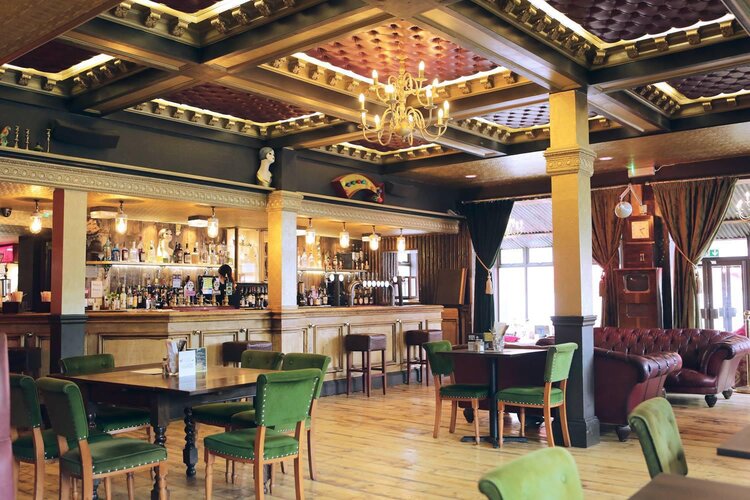
Also in February, Mitchell and Ball, billed in music hall promotor Harry Belmont’s usual gloriously flamboyant style, as “The Muscular Middleweight Marvels” and “those Popular Professors of Pugilistic Prowess”, boxed three “biffin bouts” twice nightly at Belmont’s Sebright Music Hall, Hackney Road.
The venue’s main attraction across the month was a man called Joseph Parker who had “very muscular thighs”, and could leap 25ft across a stage in only two jumps without a run up, make a 13ft jump from standing on the edge of an upended brick, and travel an extraordinary 9ft jumping backwards.
There was also a quaint little poodle who performed military marches.
The Victorians really did know how to have a good time.
I’ve got a lot more to say and do on Ball but currently typing up as I research, and it’s slow progress between work, other work, and incubating a baby.
Alf Ball Part III coming soon
 Rediscovering the wrestlers and boxers of Late-Victorian London
Leave a comment